
Peru
A behemoth of Latin American biodiversity, Peru’s biological prowess is a testament to South American biodiversity. Over 60% of Peru’s territory is covered by the Amazon Rainforest, which makes Peru the country with the second largest portion of the Amazon in its borders, behind only Brazil. Thus, it is no surprise that Peru was featured in the Conservation International’s 1998 list of megadiverse countries. Hence, Peru is a hotspot for up-and-coming biologists and veteran biologists to stake their claim in their respective fields. One such biologist is Mirko Zimic, a Principal Investigator at Universidad Peruana Cayetano Heredia (UPCH). Mirko started his scientific journey studying Physics at Universidad Nacional de Ingeniería in Peru. Then, after studying biochemistry at UPCH for a master’s degree, he travelled to the US to complete his PhD in control and prevention of diseases. Yet, Mirko left his life in the US to contribute to Peruvian scientific development. A huge impact which contributed to Peru’s scientific corpus was the inauguration of president Ollanta Humala, who drastically increased the amount one could get from a scientific local grant. Along with his body of well-renowned scientific advisors, Humala ushered a radical change in Peruvian scientific progression, the likes of which Mirko refers to as ‘the birth of scientific development in Peru.’ This blog details the importance that Peruvian scientists, both home and abroad, have had on the field of microscopy.
An interview with Samira Vera
Posted by Mariana De Niz, on 8 August 2023
An interview with Carlos Bustamante
Posted by Mariana De Niz, on 11 July 2023

An interview with Brenda Delfin
Posted by Mariana De Niz, on 6 June 2023
MiniBio: Brenda Delfin is a researcher at Universidad Peruana Cayetano Heredia, in Lima, Peru. She is a Biologist by training, and has specialized in Neuroscience. She is currently head of the animal house and interim leader of the Neuroscience of development lab at UPCH. Joining her expertise in neuroscience and her passion for teaching, learningAn interview with Mirko Zimic
Posted by Mariana De Niz, on 30 May 2023
An interview with Rosa Isela Gálvez
Posted by Mariana De Niz, on 23 May 2023
An interview with Iskra Tuero
Posted by Mariana De Niz, on 16 May 2023
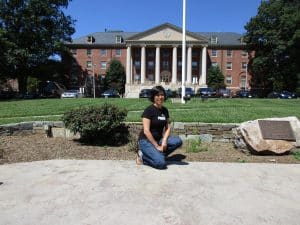
An interview with Piere Rodriguez-Aliaga
Posted by Mariana De Niz, on 9 May 2023
Get involved
Create an account or log in to post your story on FocalPlane.
Have an idea for a blog series?
You may also be interested in these blog series: