

SfN, Then and Now: Returning to Neuroscience’s Largest Conference as a Postdoc
Posted by Sally Horton, on 17 December 2025
The Society for Neuroscience (SfN) annual meeting has a reputation: enormous, extraordinary, and exhausting. This year, I returned to SfN in San Diego for the second time in my scientific journey, but for the first time as a postdoc. Although the location was the same as my first SfN as a PhD student, the experience felt markedly different. It wasn’t smaller or less overwhelming, but it was far more rewarding, I genuinely got more out of the meeting.
My first SfN felt like being dropped into the deep end of neuroscience. I was struck by the scale of the meeting and the sheer breadth of research on display, and I remember rushing between talks and posters, trying to see everything. This time, while the meeting was just as vast and varied, I approached it with more intention. I knew which conversations mattered, which sessions to prioritise, and when it was better to stay by a poster to network rather than rush to the next talk.
Big, Broad, and Unapologetically Varied
SfN remains one of the most varied scientific meetings I’ve ever attended. Molecular mechanisms of synaptic function sit alongside whole-brain imaging, development, disease models, and translational approaches. To some, SfN may lack the depth of a smaller specialist meeting. However, it offers something equally valuable: perspective. Seeing similar questions approached from entirely different angles can be surprisingly clarifying.
And, of course, there’s the exhibition hall. SfN wouldn’t be SfN without rows of sponsors, endless coffee, and an impressive amount of free merchandise. For me, this year’s standout freebie came from Chroma: alignment slides for different wavelengths for fluorescent microscopy. Not flashy, but genuinely useful, and already transformative for my imaging. It reminded me that some of the most practical takeaways can come from talking to sponsors and picking up tools that quietly improve everyday experiments. Although I’ll admit, I still love leaving with a new coffee mug or water bottle featuring a neuroscience logo.
Presenting a New Project (and Letting People Pull It Apart)
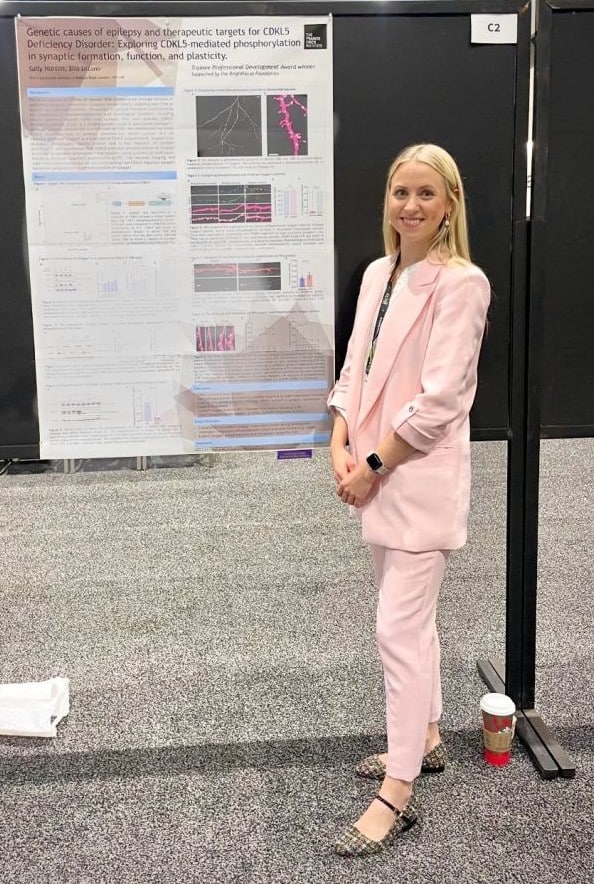
Presenting a poster on a new project is always nerve-wracking: the story is still being refined, and suddenly you’re opening it up to critique from people who have spent years thinking about similar problems. But poster sessions are also among the most valuable parts of a meeting like SfN.
The discussions around my poster were some of the best I’ve had at a conference. People asked thoughtful, sometimes challenging questions about mechanisms and interpretation. Several conversations pushed me to think carefully about how molecular changes at synapses translate to physiology and circuit-level outcomes, and how compensatory processes might complicate models. Being asked detailed technical questions also reinforced my confidence in the robustness of my experimental approach.
What stood out most was how constructive these interactions were. Rather than feeling exposed, I felt supported. Many people were genuinely excited by the work and interested in where it might go next. A recurring theme was the importance of linking structural and molecular observations to function, a point I will continue to address to strengthen the project as it develops.
Familiar Faces and a Growing Community
One of the biggest differences from my “PhD SfN” was how many familiar faces I encountered. I caught up with colleagues from my former institute, my old lab, and people I’d met at previous conferences. Many remembered my work and followed up on earlier conversations. That sense of continuity, of being part of an ongoing scientific dialogue rather than a series of one-off interactions, was deeply reassuring. It made the meeting feel less anonymous and more like a community I am increasingly becoming a part of.
I was also fortunate to attend as a trainee professional development award winner, with additional support from a FocalPlane travel grant. Beyond the practical benefits, this support reinforced a sense of belonging: that my work was valued and worth investing in, and that I deserved to be in those rooms having these conversations.
Posters, Talks, and Healthy Skepticism
SfN posters are where much of the real scientific texture lives. I saw work ranging from synaptic stability and spine-associated proteins to developmental changes in dendritic structure and nanoscale synapse organisation. Across these diverse studies, common themes emerged: synaptic maturation, excitation-inhibition balance, network stability, and how developmental disruptions can have long-lasting consequences. Seeing these ideas recur across different scales, systems and models gave a sense that the field is converging, even if the details remain complex.
Surprisingly, some of the most engaging discussions came from posters whose conclusions I initially questioned. High-resolution imaging and sophisticated analyses are undeniably powerful, but they naturally led me to critically evaluate the interpretations, particularly as I questioned the health of some neurons in the images, and to consider how confidently structural observations could be linked to function.
These moments of skepticism were invaluable, not dismissive, but sharpening, and served as a timely reminder of the importance of critically evaluating even the most polished-looking data, including my own.
Big Talks and Long Views
The larger talks and presidential lectures offered a different kind of insight. Rather than focusing on individual experiments, they provided long-term perspectives on how ideas evolve and how scientific careers unfold. Hearing senior scientists reflect on decades of work was grounding. As a postdoc, it’s easy to feel pressure to already have a clear, polished story, but these talks reminded me that impactful science is often nonlinear, shaped by persistence, collaboration, and time. One key takeaway was just how many people it takes to build a successful project, underscoring the importance of collaboration and knowledge sharing.
Leaving Tired, but Energised
By the end of the week, I was exhausted. Conference fatigue is real, and it doesn’t necessarily get easier with experience. But I also left energised, full of new ideas, sharper questions, and a clearer sense of where my work fits into the broader neuroscience landscape.
Returning to SfN as a postdoc didn’t make it less overwhelming, but it did make it more meaningful. I was more critical, more confident, and more engaged. San Diego was the same as my first SfN, but I wasn’t. And that made all the difference.
For PhD students and early career researchers: it really does get better. Big meetings like SfN can feel daunting at first, but networking doesn’t have to be intimidating, it’s often just chatting about science, asking questions, and being curious.
 (2 votes, average: 1.00 out of 1)