

My participation at the GloBIAS Conference 2025 in Kobe Japan
Posted by Beatriz Serrano-Solano, on 22 January 2026
This article was written by Dr Libert Brice Tonfack, Associate Professor in Plant Biotechnologies at the University of Yaounde I, Cameroon.
Upon returning from my active participation in the first conference organized by the Global Bioimage Analysts’ Society (GloBIAS) in 2024 in Gothenburg, Sweden, I immediately understood that I needed to commit strongly to the society’s activities. The official recognition of GloBIAS as a scientific society gave me the opportunity to become an active member and to take on my role as an ambassador in Cameroon and in Africa, where I was already a member of the African Bioimage Consortium (ABIC). I began communicating, during scientific and academic events in Cameroon and across Africa, about GloBIAS activities and encouraging young African researchers to join.
The call for applications for the Bioimage Analyst Conference organized by GloBIAS from October 26 to 31, 2025 at the RIKEN Center for Biosystems Dynamics Research (BDR) in Kobe, Japan was an opportunity not to be missed.
I decided to apply to attend the training school and the conference because my objective was to continue and strengthen the promotion of microscopy in Cameroon and in Africa, in the domain of Plant Science research, through facilitated access to tools and expertise, and via training and networking opportunities. By coupling technology dissemination with expertise and training, I can help design a program to serve as a crucible for the sustainable development of imaging expertise across Africa. Although capacity-strengthening efforts in some African regions suffer from multilayered challenges, they also present a space for development and innovation. Moreover, the implementation of the “one health” concept involves giving more interest in underrepresented domains like Plant Science. However, scientists in Plant Science still face constraints like funding, accessibility to high-tech in bioimaging, infrastructure, and technical expertise. Yet Plant Science is on the frontline against food security, environmental pollution, non-communicable diseases, and social development. As a leader of a research team, my participation in GloBIAS 2025 was a great opportunity to share our findings on Plant Imaging.
The possibility of receiving a Travel Grant for citizens from low-income countries was an additional source of motivation for me and for many young Africans. Despite the budget limitations, the organizing committee of the GloBIAS Conference 2025 quickly found an alternative solution. I was very pleased to learn that the Japan International Cooperation Agency (JICA) had agreed to cover my travel expenses. The organizing team demonstrated exceptional professionalism in facilitating my visa application, handling my reservations, and providing valuable advice for my very first trip to Japan.
Bridging science and culture: My preparation and conference experience in Japan
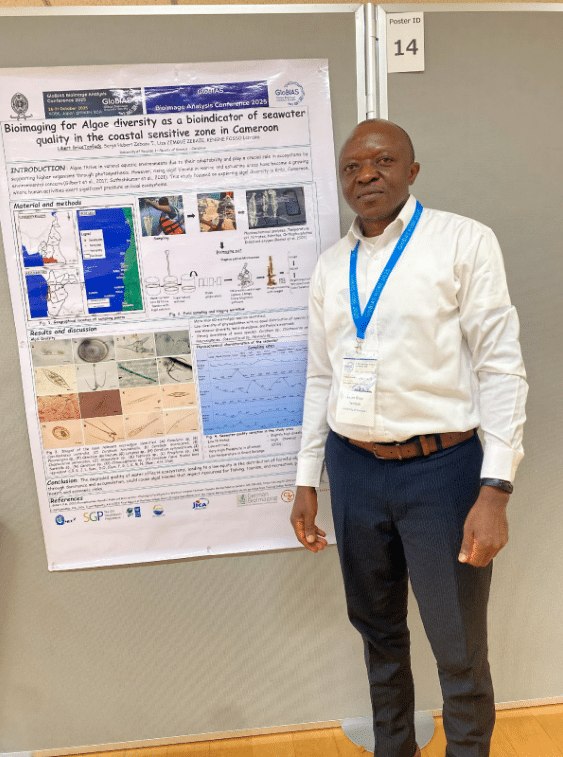
Preparing for the trip was an adventure in itself. Between finalizing my poster on “Bioimaging for Algae diversity as a bioindicator of seawater quality in the coastal sensitive zone in Cameroon”, I barely had time to reflect on what awaited me. Yet, as the plane descended over Japan, I was struck by the country’s meticulous order and beauty. From the efficiency of the trains to the politeness of everyday interactions, Japan immediately impressed me with its balance of tradition and modernity.
When I first stepped into the bustling streets of Kobe on October 25, 2025, I felt a mix of excitement and nervous anticipation. I had traveled thousands of kilometers from Cameroon to Japan to participate in an international training school and Conference on Bioimage Analysis—a field that has become both my passion and research focus. This was more than just a scientific event; it was a chance to share my work, learn from global experts, and immerse myself in a culture I had long admired from afar.
Training School and conference experience
The four days of intensive training (26-29 October 2025) allowed me to revisit the fundamentals of Bioimaging before becoming familiar with workflow management, with a particular focus on Napari, Fiji, QuPath, CellProfiler, etc. The trainers gave me the opportunity to build skills in BARD, Docker, and Nextflow within the field of High-Performance Computing. They further immersed me in Machine Learning by giving me the chance to get hands-on experience with tools such as CellPose-SAM and Ilastik. As part of the hands-on work on trainees’ projects, I was fortunate that my project entitled “Morphological description of Aframomum spp. seeds with WIRS” was selected. This allowed our group to put into practice the concepts learned during the training by using Fiji and Napari to analyze the WIRS images from seeds. Participants in group work were very happy and we decided to continue our close collaboration after the conference.
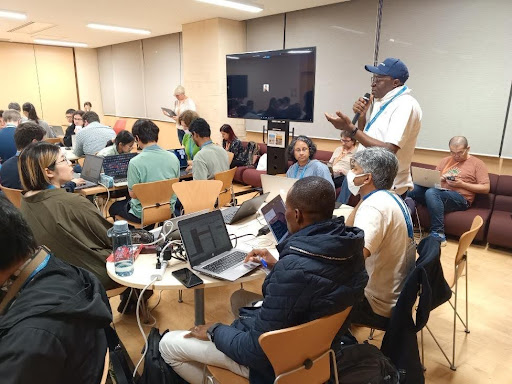
The conference venue was a hive of energy. Researchers from across the globe gathered to present cutting-edge work in microscopy, imaging software, and biological applications. Walking through the poster sessions felt like stepping into a living library—each conversation opened a new window into the possibilities of science.
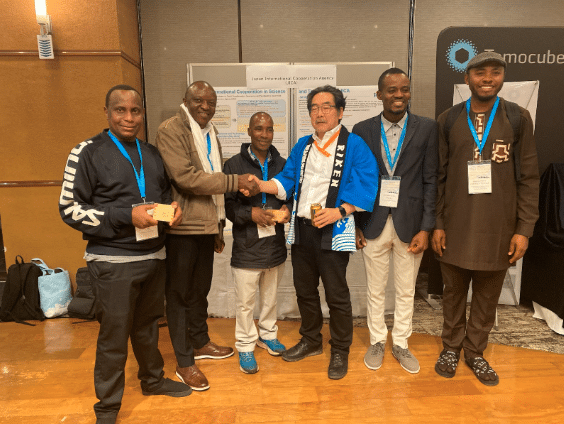
My own poster presentation focused on “Bioimaging for Algae diversity as a bioindicator of seawater quality in the coastal sensitive zone in Cameroon”, a topic that bridges imaging technology with environmental assessment and algae biology. Standing beside my poster, I explained how tiny, microscopic diversity of algae species can be visualized, analyzed, characterized and identified using imaging tools. The questions I received were very inspiring. One researcher from the USA suggested using advanced tools for better characterization, while another from Japan shared insights on integrating Napari workflows in algae image analysis. I was very happy to discuss my findings with Dr MATSUSHITA Yoshihisa, the Advisor of the Office for Science, Technology and Innovation, Digital Transformation Governance and Peacebuilding Department of the Japan International Cooperation Agency (JICA), who encouraged me to collaborate with Japanese institutions and apply for JICA funding. These exchanges reminded me that science thrives on collaboration and dialogue.
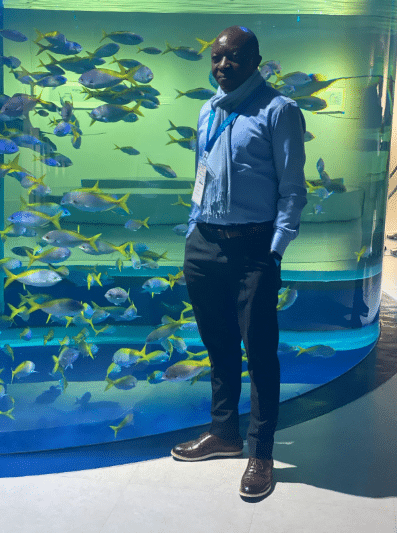
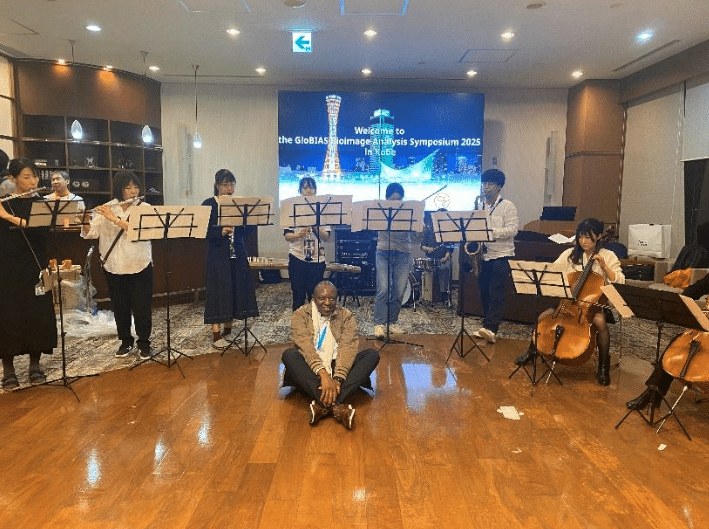
Beyond the formal sessions, the conference offered countless opportunities to connect. Over coffee breaks with special delicacies, excursion with brewery tour and evening sociocultural receptions like dinner at Shushinkan and at the High-Tech Kobe Urban Aquarium, I met other scientists who were equally passionate about bridging research with real-world impact. A memorable conversation with a researcher from the University of Tokyo, Japan revolved around sustainable development and how imaging could help improve local development through the valorization of undervalued plant species. It struck me how similar our challenges were, despite working continents apart.
These interactions planted seeds for future collaborations. I left with not only new contacts but also a renewed sense of belonging to a new global scientific community.
Cultural & Personal Impressions: Discovering Japan Beyond the Conference
Of course, no trip to Japan would be complete without exploring its rich culture and monuments. After the symposium session, I visited the Kyoto Tour and sampled local cuisine. Sushi tasted fresher than I had ever imagined, and the quiet beauty of a tea ceremony or the tradition behind the highest quality sake drink offered a moment of reflection amid the busy schedule.
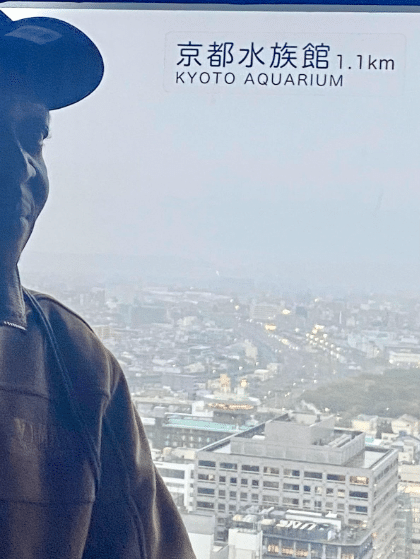
What fascinated me most was Japan’s approach to urban sustainability. The integration of green spaces within dense cities resonated with my own interests in community development back home in Yaoundé. I found myself imagining how similar principles could be adapted to improve urban life in Cameroon—improving spaces that nurture both people, the tradition and the environment.
Lessons and Takeaways
The training school and symposium at the GloBIAS conference 2025 were more than an academic milestone; it was a personal journey of growth. Professionally, I gained exposure to new imaging techniques, learned about international suppliers of advanced equipment, and discovered innovative approaches to plant morpho-physiological analysis. Personally, I grew more confident in presenting my work to a diverse audience and more motivated to continue bridging science with policy and community development.
One key takeaway was the importance of inclusion in science. Seeing researchers from different backgrounds and countries come together reinforced my belief that diversity enriches discovery. It also reminded me of the responsibility I carry to ensure that scientific progress benefits not just laboratories, but communities. I strongly believe that my trip in Japan will have a long and lasting impact on my career and not only on global scientific, but on local traditional communities as well.
As I boarded my flight back to Cameroon, I carried with me more than just conference notes and business cards. I carried inspiration to refine my imaging workflows, to push forward community-based environmental and agricultural projects, and to continue advocating for inclusive scientific practices. Japan had given me both knowledge and perspective, and I was determined to translate that into more impact at home.
Attending the GloBIAS conference 2025 was a reminder that science is a shared language—one that connects us across cultures, disciplines, and continents. And in that shared language, I found my voice strengthened, my vision broadened, and my commitment renewed.
Finally, participating in the GloBIAS conference 2025 in Kobe, Japan was a transformative experience. It was about science, yes, but also about culture, connection, and growth. The lessons I learned will shape not only my research but also my contributions to sustainable development in Cameroon.
Are you passionate about bioimaging, scientific collaboration, or sustainable development? Join GloBIAS, connect with global experts, and help build a more inclusive scientific community. Your voice and vision can make a difference—get involved today!
Libert Brice Tonfack
Associate Professor
Plant Biotechnology
Department of Plant Biology
University of Yaoundé I
Cameroon
 (2 votes, average: 1.00 out of 1)