
Crick BioImage Analysis Symposium (2025) – a review
Posted by Stefania Marcotti, on 12 January 2026
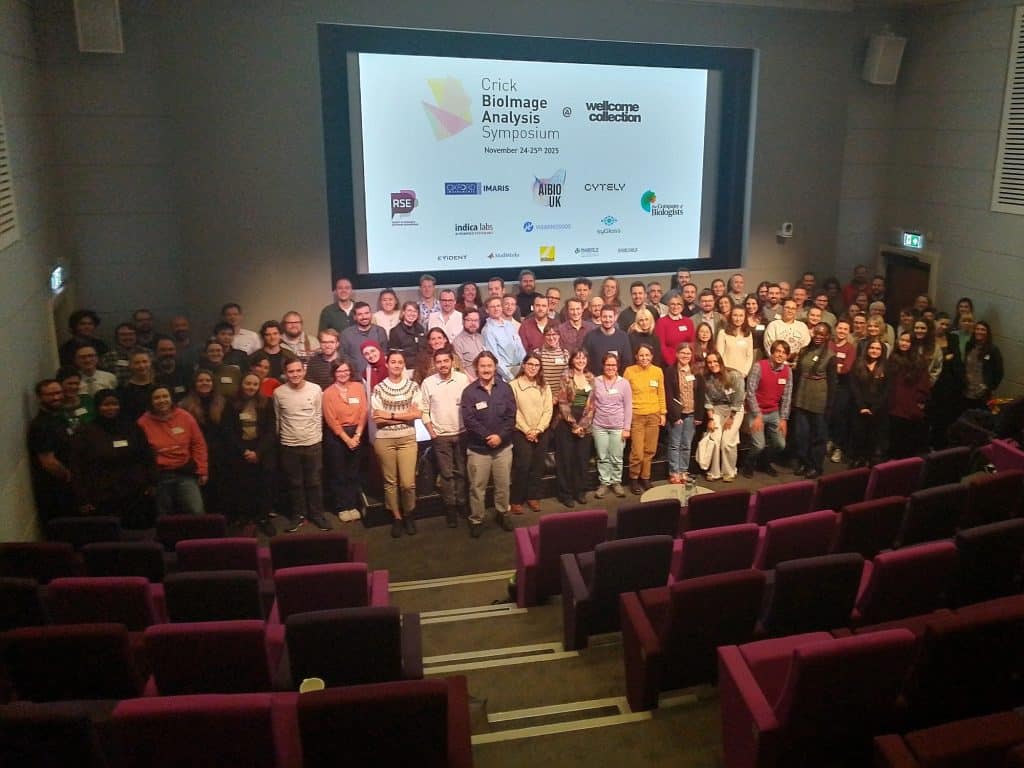
The Crick BioImage Analysis Symposium 2025 (#CBIAS2025) took place in London in November 2025. We asked three early-career participants, Jacqueline Chalakova, Anna Foix and Deniz Bekat, to tell us how it went. Read below for what they had to say!
—
Jacqueline Chalakova
This was my first time participating in the Crick Bioimage Analysis Symposium, and I was pleasantly surprised to find myself in a room full of people who truly value interdisciplinary research. What stood out most was the passion for building collaborations and sharing knowledge—not just reporting findings.
Every talk and poster offered something enriching, whether it was a new perspective I hadn’t considered before or insights into incredible tools and how to access them. I left with countless ideas for my own work, many of which I’m already putting into practice as I write this. More importantly, I felt like I had become part of a community of like-minded, welcoming people eager to help and share their experience. Through informal discussions between sessions, I even received invaluable advice on solving problems I’d been struggling with in my own data.
The conference sessions did an excellent job of representing the breadth of work in the community. It began with the Biomedical Applications in Image Analysis session, where I eagerly typed notes on familiar tools like Ilastik and exciting new ones such as Spotiflow. In the Plants and Animal Imaging session, Andy French’s talk on building pipelines and models for heterogeneous image segmentation was particularly informative. Jonas Hartman’s presentation on constructing an image-atlas segmentation was full of valuable principles and approaches to image analysis.
It was eye-opening to hear from Luigi Martino of the Wellcome Trust, who encouraged interdisciplinary applications while acknowledging the lack of funding dedicated to software sustainability. On that note, the Software Sustainability session was packed with insights—ranging from newer formats like OME-Zarr (Kimberly Meechan) to detailed applications of TrackMate macros (Jean-Yves Tinevez).
Without a doubt, I would love to participate—and hopefully present—at the conference next year. It was one of the most enriching and inspiring meetings I’ve ever attended, and that’s no exaggeration.
I was also fortunate to join the Napari workshop following CBIAS. It provided a comprehensive, step-by-step introduction to Napari and its major plugins, accessible to all experience levels. On the second day, my team and I completed a task that, without the support of the instructors—Cameron Shand, Rocco D’Antuono, Giulia Paci, Marie Held, Ana Stojiljkovic, Joost de Folter, Stefania Marcotti, and Sara Salgueiro Torres—would have taken three times longer, or we might have given up on entirely.
Now, I feel empowered to develop more sophisticated image analysis pipelines and even work on building software to make these tools accessible to less experienced staff.
—
Anna Foix
Programme structure
I’ve been going to CBIAS every year since the start of my PhD, back when I had very little experience in bioimage analysis and was still figuring out what “the field” even looked like. Coming back now, with a much clearer sense of the landscape and the community, I’m always impressed by how deliberately CBIAS is put together. The programme is very inclusive, in the best sense: it spans the whole bioimaging pipeline. You can start the day with talks that go deep into acquisition and microscopy methods (including the practical realities of getting good data), then move through processing and quality control, and end up in the more “classic” analysis — segmentation, tracking, quantification — and finally the
downstream biological questions that those analyses are meant to serve. That breadth isn’t just a tick-box exercise: it’s what makes the meeting feel coherent even though the community is very heterogeneous.
What I appreciate most is that CBIAS is built around interaction and exchange. It’s a space where different kinds of expertise (wet lab, imaging, software, machine learning, infrastructure) can actually meet in the same room and talk to each other without anyone feeling like they’re “not the right audience”. You also see that reflected in the speakers: there are established researchers and group leaders but there’s a real effort to give visibility to early-career researchers who are still building confidence, testing ideas, and learning how to present their work.
Another strength this year was the balance of academic research with software and infrastructure. It wasn’t only “state-of-the-art methods” talks; there was room for tool builders and software engineers to share meaningful updates, and for industry to show what’s happening outside academia in microscopy image analysis. And I loved seeing initiatives aimed at strengthening the community, things like training platforms and broader coordination efforts (GloBIAS and others) because those are easy to miss when you’re head-down in your own project, but they really shape what becomes possible for everyone.
Finally, CBIAS continues to feel international in a way that matters. Even though it’s rooted in the UK community, it isn’t country-centric: the mix of institutions and countries in the speaker list and poster hall makes it feel like a real forum for the wider European and global bioimage analysis ecosystem.
Poster session
The poster session is always one of my favourite parts of CBIAS, and this year was no exception. The overall spread felt well balanced. It was a mix of microscopy/imaging-focused posters and bioimage analysis method development. What I especially enjoyed this year was seeing posters about resources and community support alongside the science. Things like the BioImage Archive and other infrastructure efforts can sometimes sit in a separate box, but having them in the same poster hall makes it obvious how central they are to the day-to-day reality of doing reproducible science. I also appreciated posters focused on training, support, and community programmes initiatives that many of us simply aren’t aware of until someone puts them directly in front of us. As a final-year PhD student, that felt particularly relevant: not only for practical reasons (funding, training opportunities, mobility), but because it helps you see where you can contribute and how to stay connected to the community as you move into the next stage.
Discussion panel highlights
CBIAS panels are consistently one of the most interesting parts of the conference for me, because the organisers tend to pick topics that are hard to talk about because sometimes they are overseen by many of us. This year’s panel on software sustainability and funding really stood out. Having worked my whole career around public infrastructure and community resources, I know how uncomfortable these conversations can get: everyone relies on open-source tools, but long-term maintenance, funding models, and recognition are still messy and often awkward to address. What worked well was that the panel didn’t stay abstract. Different panellists brought different perspectives, and the moderation left real space for audience engagement.
Participants and panellists shared lived experiences, and admit what isn’t working and propose new ideas that can be tested in the future. The discussion wasn’t left like a neat consensus, and that’s fine. I did leave feeling that the panel achieve something important: it opened the debate properly, surfaced the tensions, and made many of us think beyond our own default perspective.
Talk highlights
My personal highlight was Ewa Paluch’s talk. It was a really good reminder of what bioimage analysis looks like at its best: not methods for the sake of methods, but quantitative imaging as a way to answer deep biological questions and to open up questions we simply couldn’t ask before. I also really enjoyed hearing from Albert Dominguez, presenting work on spot detection from EPFL — very strong technically, but also based in what the task actually demands in practice. And Teun (Biohub, San Francisco) did a great job making the case for why visualisation is not an “extra”, especially when you’re dealing with 3D and tracking data. The talk captured something that many of us feel: the analysis can be technically correct, but if you can’t explore and communicate it properly, you lose a lot of scientific value (and you lose people).
Will CBIAS 2026 be relevant for you?
If you’re in the bioimage analysis community, I genuinely think CBIAS should be a yearly must. For early-career researchers, it’s one of the best places to start building a network that actually makes sense for this field: you meet people doing cutting-edge work, you see what “good” looks like across different sub-communities, and it’s a very natural environment for collaborations to start. It’s also a surprisingly good place to learn what opportunities exist not just jobs, but training, infrastructure initiatives, and ways to get involved.
For more senior researchers, it’s a forum to sanity-check ideas with peers, see what the next generation is building, and share work in a setting that tends to encourage genuine discussion rather than just broadcast. It’s also a great place to make your lab visible to people who might be looking for their next step and to do that in a way that feels welcoming. More than anything, CBIAS has a warmth to it that isn’t guaranteed at conferences. Talking to more experienced scientists gave me a clearer sense of how the field has changed and where it might be heading, and the poster session atmosphere made it easy to have real conversations with people working on similar problems. That sense of community of recognising familiar faces and also meeting new ones in a low-barrier way is one of the 2reasons I keep coming back and I will for the years to come.
—
Deniz Bekat
I had the honour of being able to attend CBIAS 2025 for the first time, which was hosted at the Wellcome Centre this year. I had no clue what to expect of it; I’ve only recently began work in image analysis and was concerned of things going over my head. Luckily, that wasn’t the case! From the beginning, the atmosphere was friendly and informal and gave amazing opportunities to meet experts in the field who were happy to talk about different topics.
The day started with some refreshments and went straight into the talks. The attendance in-person was enough to almost fill the auditorium, as well as those attending online, thanks to the hybrid setup of the event. The talks were separated into different topics; this started off with Biomedical Applications of Image Analysis, starting off strong with a talk on Ilastik from Dominik Kutra from EMBL (which was a strong start for someone who uses Ilastik in their work, like me!). The talks then continued with a wide range of fields and topics, all centred around image analysis.
After the first round of talks finished, we had lunch and more refreshments, which was a great chance to meet some more people and ask questions from those who had already given talks. This was also the first time that the poster exhibition was available to everyone – CBIAS had 37 posters in the fields of image analysis with a broad range of topics, from microscopy community to novel projects in both electron and light Microscopy. I particularly enjoyed this as one of the posters was mine, and I attracted the attention of those with similar experience that offered invaluable advice and started some very interesting discussions on the topic and beyond. Having a chance to walk around the room to view other posters as well, it was inspiring to see so many posters on novel and unique methods, with a great networking opportunity in chatting to those presenting their own posters.
After lunch, the talks changed topics, from Plant and Animal Imaging and then to Community Building, highlighting the importance of national and international collaboration with talks from both GloBIAS and the Wellcome Centre. After all the talks were finished, a panel discussion in software sustainability and funding created quite lively conversation and debate! Finishing the day off was a series of flash talks – my personal highlight was by Aafke Gros, using Blender to visualise 3D images.
After the day was done, things became a bit more relaxing with dinner and drinks at a nearby Pub in Somers Town; this was extremely fun and I received great advice from a range of people at different points in their career, from PhD students, to postdocs, all the way to exerts in their fields working within facilities!
Day two was very similar in structure to the first, with a great list of talks in physical and mathematical modelling (my personal favourite theme of the event!), research integrity, and software sustainability. As the posters had been mostly taken down, day two was more focused on networking in my view, with the lunch and refreshment breaks providing a chance to ask questions and introduce yourself. With the day concluding at around 4pm, it left a great impression and time for contemplation about all the talks and discussions of the event. For those who had applied and offered a place, there was also a workshop on napari on days 3 and 4, which I did not have the chance to attend, but would wholly recommend for those interested in 3D visualisation.
Overall, I would wholeheartedly recommend this event to anyone who is interested in image analysis and wants to be more engrossed in the community and the range of techniques and new frontlines of software and techniques While it might not be fully suitable for those just beginning, at risk of things becoming overwhelming, there was certainly content for everyone, whether you are from a more biological or physical background. A big thanks to all the organisers who helped this happen, I can’t have imagined a better experience for my first CBIAS symposium!
 (2 votes, average: 1.00 out of 1)