

Interview with Aníbal Vargas Ríos, LiSIUM initiative coordinator
Posted by Helen Zenner, on 17 February 2026
Following The Company of Biologists’ Workshop in Ecuador, I caught up with Aníbal Vargas Ríos for an update on the Light-Sheet Imaging Universidad Mayor (LiSIUM) initiative. Aníbal is a postdoctoral researcher at Universidad Mayor and coordinator of the LiSIUM initiative. We discussed Aníbal’s path to his current position, his favourite moments as part of the LiSIUM team and what to look out for from the team in 2026. You can find out more about the origins of the LiSIUM initiative in Mariana De Niz’s interview with Alenka Lovy: https://focalplane.biologists.com/2024/01/24/enhancing-global-access-interview-to-czi-grantee-alenka-lovy/
Can you describe your career path so far?
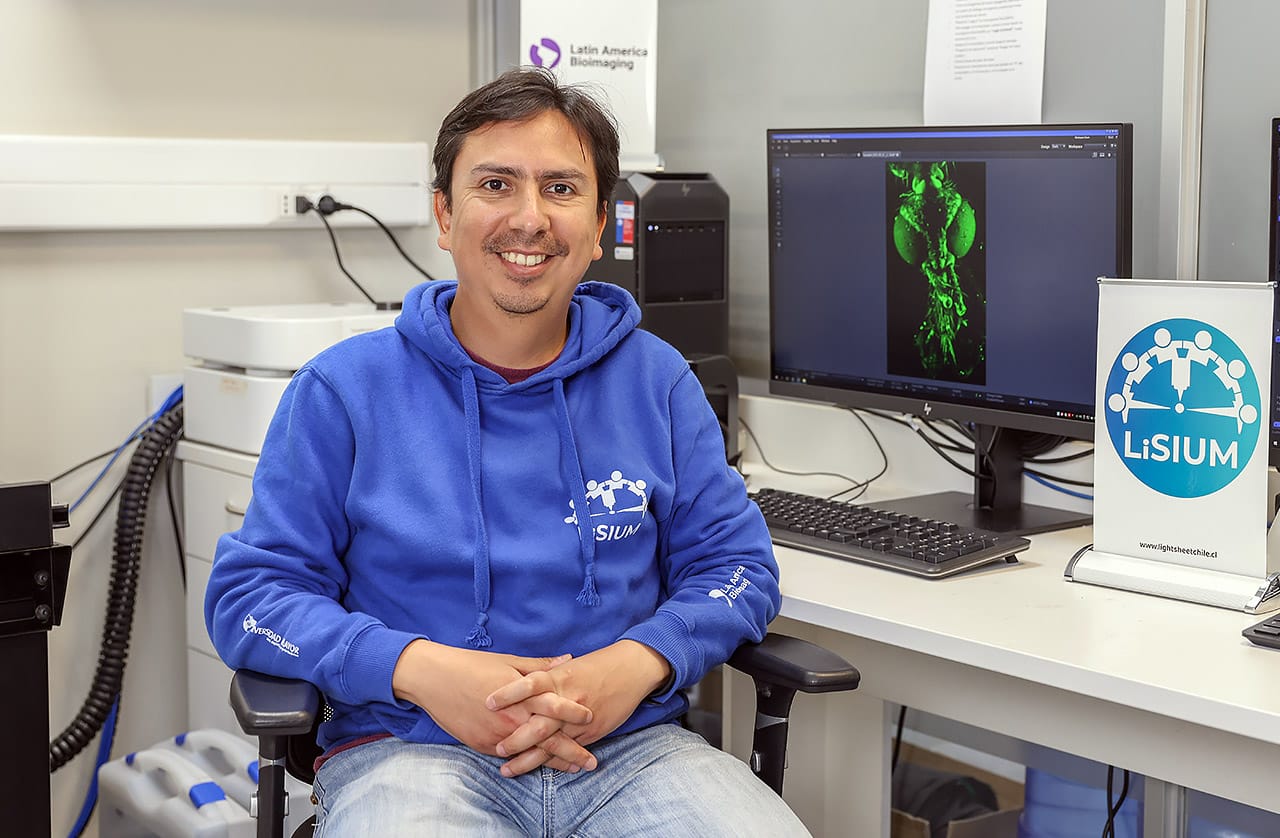
I am a biologist from Pontificia Universidad Católica, here in Chile. I obtained my PhD title in physiology in 2018 at the same place. My PhD training was in cell communication with a strong component in electrophysiology. In this field, you have to really understand the equipment you are working with, because you need to be able to disassemble and re-build the equipment for every experiment if needed. The technique requires you to avoid noise, and even a small electrical noise can upset the system. So, you need to constantly review your set up. I think it was my curiosity in understanding the equipment, and developing my own skills in this, which led me to microscopy. Now, I have a postdoc position in Universidad Mayor, specialising in light-sheet microscopy. It is a special postdoc, because it’s not for research production itself; the principal goal is to promote the use of light-sheet microscopy rather than to write papers. All my background and skills now serve me to promote light-sheet technology and all the methodology that surround the imaging, from the sample processing through to image processing. In fact, these latter two things are probably more important than the microscope, because you need to feed the light-sheet with good samples and validate the technology with a good image. My job here is to present, promote, and incentivize the use of light-sheet microscopy. It’s important to break the inertia to try something new, to encourage researchers to explore the advantages, possibilities and opportunities of a new technology rather than always turning to their regular methods. We teach researchers how they can develop their projects and use the equipment correctly to accomplish their research goals.
You’ve already covered this a bit, but could you remind us of the goals of the Light-Sheet Imaging at Universidad Mayor (LiSIUM) initiative?
The goals of LiSIUM are, first of all, the promotion and the democratization of the light-sheet technology in Chile, and in the rest of South America. A key part of this is allowing researchers to access the equipment openly and without cost for their first experience. We try to break the barriers to using light-sheet microscopy. There is a geographical barrier and an economic barrier but, as I mentioned before, there is also an emotional barrier too. Neophobia is very common when researchers are very comfortable with the technology that they are currently using, but it is often the case that trying a different technique could help you make another step towards your objectives and answering your questions. Of course, there is pressure to get results fast and it can be hard to stop to take time to learn new things, especially when you don’t know if they will work. This is where our project comes in, since we collaborate with researchers it means they don’t necessarily have to learn everything at the beginning of their project because we are there to support them. Then, if they become regular users, we can teach them more about the technology. So, those are the principal goals: democratization of the light-sheet technology and allowing open access.
Where does your funding come from?
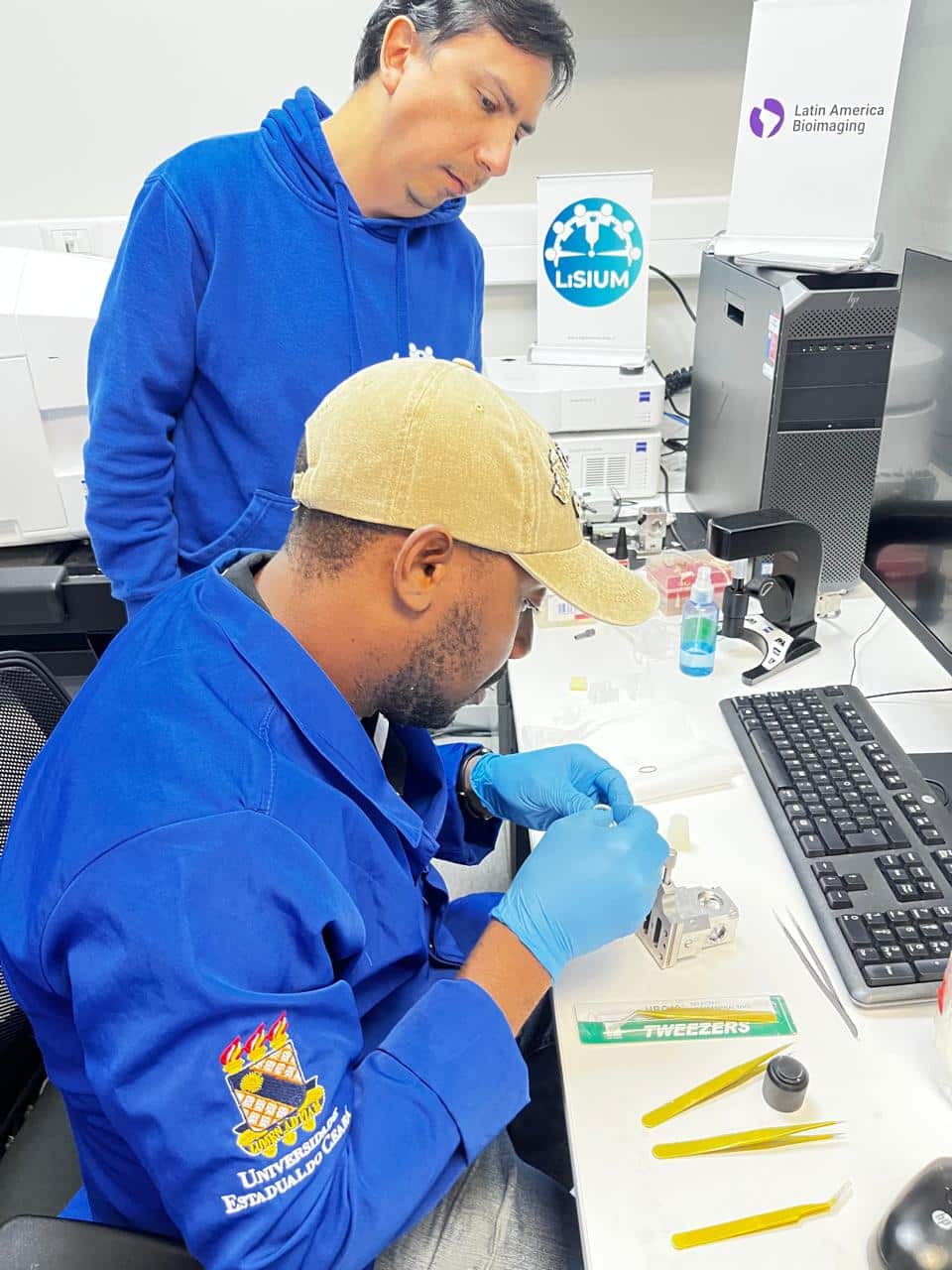
The project has been funded by a grant from the Chan Zuckerberg Initiative (CZI). It’s a special grant, because in Chile, and South America, it is not common to get funding for a project that is focussed on making a technology freely available and to build a collaborative network and a support network. In the case of light-sheet microscopy, this type of grant is essential as the technology is very expensive, making the cost prohibitive for a lot of places. And, because we don’t have many heavily and widely used light-sheets in our region (while there had been some prior lab-built equipment, ours was the first multi-purpose commercial device), one of the principal things that the grant covers is the use of the light-sheet, as you would typically have to pay per hour for use of a microscope. With us, users can have ~8-16 hours on our equipment for free. This grant also allows us to run activities like workshops, to provide support to other courses and to participate in outreach activities. And importantly, the grant pays for a specialist who is dedicated to taking care of the light-sheet and the protocols around it. That’s me and my salary is from CZI. Now, the university is looking at how we can retain this capacity, since the funding is only a few months away from ending. We’ve had other smaller grants to help fund workshops or to organise events, but we don’t have other grants that have given us the opportunity to create a new position for a specialist and to install the capacity of this new technology. This grant allowed us to show our institution how a specialist position in a core facility can work together the researchers and how this improves productivity, the transfer of knowledge and building networks. The concept of an ‘academic specialist’ in a university is not common, not only in our country, however, I think this is crucial in a research context where millions in government and institutional funding are spent on equipment. Lacking the essential specialists to manage it, this equipment is at risk of being underused, undermining the entire investment. I would really like to continue in a similar position after this fund ends, in order to keep democratizing this technology and contribute to the growth of the collaborative network in our continent.
What would you say are the main achievements of the LiSIUM initiative so far, and what impact has it had in Chile?
Well, when we first brought the light-sheet microscopy here to our university in 2021-2022, through the Chilean Government fund FONDEQUIP, the light-sheet had very few users. But as our vision took shape in 2023 and 2024 with more networking, more outreach and more people to spread the word, we have had more regular users. We’ve imaged different samples and tried new techniques such as tissue clearing. Our users are now looking for new techniques and new samples. And we are always open to new collaborations with national researchers and those from abroad. We also have two doctoral theses where the students used light-sheet microscopy regularly. These were from our external collaborators here in Chile, added to the current ones that are being prepared at our own university, so this really shows our impact throughout the country. Internally, in our university, we also have more collaborators and we are hoping to publish a paper from the unit, along with postgraduate thesis students, describing the innovations we have made while using the light-sheet microscope, such as advances in sample preparation and mounting samples.
How can researchers connect with you to set up collaborations?
We are active on social media, on Instagram, LinkedIn and on X. We also have a webpage at https://lightsheetchile.cl/ which is our principal face to the world, and on the complete website of our microscopy unit at University Mayor, (UM2) https://cib.umayor.cl/microscopia/. All our contact information is found on that page and if people want to work with us, they can send us an email and we’ll set up a meeting to see how we can help them. This may be, for example, sending them the supplies that they would need to get started, as deliveries from companies are often delayed in South America. We are happy to share supplies during our collaborations, to save time, otherwise, after the initial excitement, the project can lose momentum. Normally after a couple of meetings, we are ready to get started with a prototype or new project within a few days or weeks.
Do you have a favourite moment since you’ve joined the LiSIUM team?
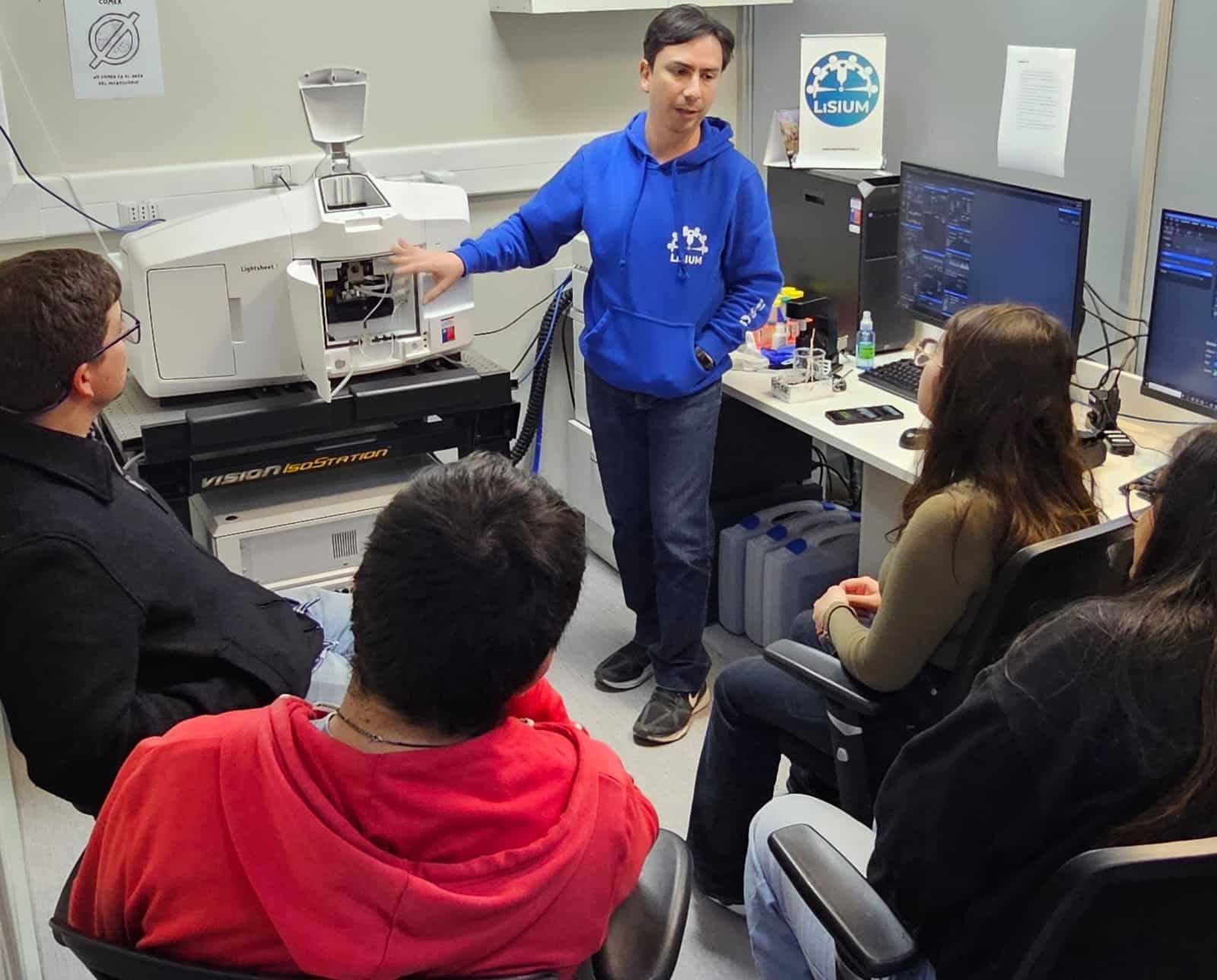
Yes, my most exciting moment was when I participated in my first EMBO course in Quintay. It’s a special international course. It’s for developmental biologists and is held in Quintay every two years. During the workshop, we were using the light-sheet microscope all day for two weeks. It’s very intensive. We were presenting the equipment to the students, so they have the in-person experience of using the microscope here in our country, which is great for the wider community, especially the Latin American community. It was really exciting because we got to try lots of different samples.
I had another ‘wow’ experience when I made my first light-sheet 3D reconstruction here at our university. It was amazing when I saw an image that could be in a publication! To see this happening in Chile, that we have this capacity in our country, it was amazing. I think it was a zebrafish with two markers and we imaged the whole organism in 3D. The output was a basic video with 360° movement in one axis and it was amazing! The initiative has also given me the opportunity to travel, to network outside of Chile, to learn from others and also to share our experience from LiSIUM-Chile.
What should we look out for from the LiSIUM team in 2026?
We have a lot of plans to keep LiSIUM-Chile going, after our CZI grant finishes in 2026. Our university, and our unit, want to keep the spirit of the initiative and to continue to democratize access to the light-sheet microscope. We are looking for several alternatives to keep our activities going, such as the ‘Open Season of light-sheet imaging’, where we offer the equipment to early-career researchers that might need to use it to get preliminary results to apply for grants. Or, we make the light-sheet available to PhD students who might use it to confirm a result in their theses.
In January, we had our workshop on image analysis for light-sheet microscopy. Each year, we are increasing the complexity of our workshops: in the beginning, we only presented the microscope, then we focussed on processing samples, and now we are on image processing! We had about 25 attendees at our workshop. Recently, we finished our first technical visit from Colombia too. In April, we’ll be hosting researchers from Brazil. We want to maintain this kind of networking to offer our experience throughout Latin America. I have received two invitations to give talks in in Colombia and in another workshop for volumetric imaging in Brazil. So, our calendar is already full of activities. This is great because people really like this technology and as more places get light-sheets, such as those in Mexico and Brazil, we are looking to reinforce our networks with these places and set up more formal collaborations.
When we were at The Company of Biologists’ Workshop in Ecuador, you spoke about the importance of thinking about language when discussing accessibility. Could you share your thoughts on this and do you have any advice for people running courses?
Yes, that is a big topic which we are always talking about when designing our activities. I think that when you are delivering knowledge, it’s so important for you to connect with the people. And this is not only the language, but it is the cultural relation with the knowledge. So, if you give an example, abstraction or analogy, you collect experience from your culture to make this comparison. I think it is harder to do this if you are talking in a foreign language. This is important in terms of accessibility because in many countries in Latin America, not everyone has the same opportunity to learn a second language at school. This creates a barrier for equal access to the knowledge that you are trying to share. So, to become a place that integrates diversity, knowledge of the ‘home’ language is necessary to truly democratise access to a technology. I do think it is important to learn a second language, however when you are within your own country, we should make adaptations to ensure that everyone can understand. If, for example, you have a speaker delivering a talk in English, some people will lose some of the information. This becomes even more important when talking about technology, because someone might be capable of using the technology, but they might not understand the instructions, the tips and tricks or they could feel inhibited from asking questions, as they are in another language, and this can become another barrier to them deciding to try a new method.
I showed in Ecuador that 50% of the non-native English speakers that we had invited to our courses, refused the invitation because the course was in English or 30% of them decide not to attend a conference. This means that we are losing a lot of experience and reducing the diversity in our field. You can find out more in this paper on ‘The manifold costs of being a non-native English speaker in science‘. I think that we really need to think how we can integrate this experience in our events. We can look at the technology that is available, for example having a computer-generated transcript in English or in Spanish. Here, I think there is still a bit of a bias in this technology where the transcription in English is more accurate than in Spanish. We need to push this to improve. Going forward, maybe we can have live translation from an interpreter for some special talks at conferences. Of course, with these live-transcription options, we can also go further than just thinking about language and make our talks more accessible for everyone.
You’ve talked about collaborations with other countries in Latin America, are you involved in any other initiatives to develop these collaborations, such as Latin America BioImaging (LABI)?
I am part of LABI. I think that it is an incredible initiative, and I would recommend that researchers join LABI because it offers a lot of opportunities to help them grow in their careers. Our initiative has a lot of support from LABI and we are very proud and glad to be a partner with them. Last year, we applied to be a host for Global BioImaging (GBI), and we were happy to be successful with our application. This means that we can host people in our unit and participate in the networking that goes alongside the initiative. LABI supported our application, and they, along with GBI, have travel grants to help people visit our facilities. I know that there are also grants available from The Company of Biologists. In fact, for our workshop at the beginning of the year we received a meeting grant of £1,000, which has allowed us to partially cover the travel costs of our attendees. For us to meet our goals, it is essential that we participate in these global and local initiatives.
Do you want to add anything further?
We recognise the responsibility that comes with our initiative. We are the only place in Chile with multi-purpose light-sheet equipment which is fully operative in an open access mode and, importantly, we are sharing the experience in using the technology with researchers and in training other core facility teams. Democratizing access is key to advancing science and we want to continue to increase the capacity in South America.
 (No Ratings Yet)
Get involved
Create an account or log in to post your story on FocalPlane.
More posts like this


Filter by
- NewsApply
- DiscussionsApply
- How toApply
- ToolsApply
- Case studiesApply
- InterviewsApply
- JobsApply
- EducationApply
- Blog seriesApply
- Volume EMApply
- Latin American Micro..scopistsApply
- Bio-image Analysis w..ith NapariApply
- Imaging with…Apply
- Towards Global Acces..sApply
- Latin America Bioima..gingApply
- From Zero to Qupath ..HeroApply
- Asian Microscopists ..and Cell BiologistsApply
- AIC at HHMI JaneliaApply
- Deep Learning for Bi..o-image analysisApply
- GloBIAS – updates fr..om the communityApply
- Highlights from Euro..-BioImagingApply
- LSFM seriesApply
- DIY MicroscopyApply
- View all