
Interview with Elisabeth Kugler
Posted by Helen Zenner, on 9 April 2026
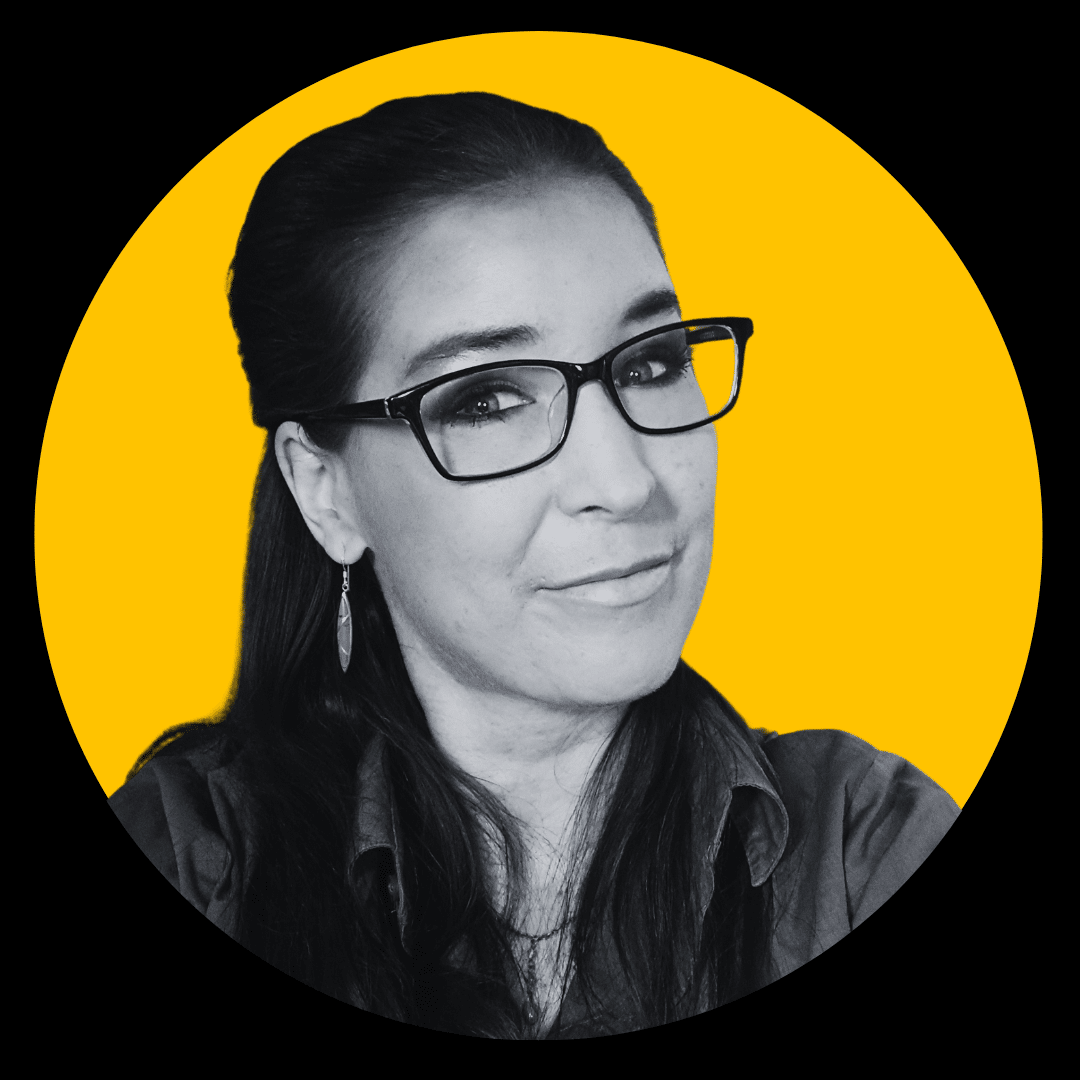
Elisabeth Kugler is the founder and director of Zeeks , a science communication and marketing company. Prior to starting Zeeks, Elisabeth trained as a biologist specialising in microscopy and bioimage analysis. I met Elisabeth over Zoom to discuss her career path, how and why she set up her company, her step-by-step approach for tackling new challenges and her future plans with Zeeks.
What first inspired you to become a scientist?
I have always been interested in nature and science, and I was naturally very curious. I was driven to learn more about nature and how things work, and that led me to study biology. Once I started I was hooked, and then when I looked through a microscope, I was really excited. It became a natural progression for me to go from biology to microscopy, and then once I had data I was immediately asking, “what should we do with the data?” and then, I fell into image analysis. It felt that I always just followed what I found exciting rather than having a plan of what I was going to do next. This involved moving from country to country, following projects that I found interesting. It was quite nice to have that freedom and just being able to see where the projects took me.
Can you tell us a bit more about your scientific journey, especially moving between countries?
I started studying biology in Innsbruck, in the Austrian Alps. I loved the beautiful, picturesque landscape there! I went on to study molecular biology in Innsbruck. During my degree, I completed some short internships, and I think these were critical for my development. The internships were six-week projects in different labs and really gave me the opportunity to try different things. I did a programming internship, and an image analysis internship. These internships gave me a different experience that I wouldn’t have gotten from more formal lectures. I moved to EMBL in Heidelberg for my master’s thesis. Heidelberg is such a beautiful environment, with lots of scientists, really vibrant atmosphere. I really flourished there. Then, I moved to the University of Sheffield in the UK for my PhD, and while I was there, I started working on light-sheet microscopy. I probably spent too much time on a microscope during my PhD, but it was just amazing. So, I had a highly performant microscope, I had an image analysis computer, and I had time to work on both.
From a biology background you made a move towards bioimage analysis, do you have any tips for biologists on how to develop their expertise in image analysis?
It can be tricky, but it’s really interesting! I think that when you’re a scientist and you thrive on challenges, you’re curious and you want to problem solve, and image analysis is a great tool, because it allows you to solve problems. As I mentioned, I think the internships were really useful because I could just try different things. My first programming internship was in Pearl, which is a very old programming language, and it was RNA sequencing analysis. I learned a lot, but the sequencing side of things didn’t capture my curiosity. For me, it was very dry compared to microscopy, where you have beautiful data and you can just spend an hour just looking at them! I think that image analysis is beautiful, but it’s very technical. If you want to move into image analysis, it can be quite daunting, but if you work with a microscope, you’re probably already doing some form of image analysis. You look at the data, and you’re trying to understand them, you might try to improve the signal to noise ratio – that’s a first step into image analysis. I think it’s important to remember that you only need to take one step, then another step and gain a little bit of momentum, and then that gets you into that new field. I think this can apply to any new field. And, for bioimage analysis there are so many cool courses and events both in-person and online. There are also YouTube channels dedicated to image analysis that literally take you step by step through image analysis tasks. So, I think it’s less about diving straight into cold water than just taking things one step at a time.
As well as considering the data-rich side of microscopy images, you’ve also used your images for artistic projects. Could you talk a little bit about that side of your work?
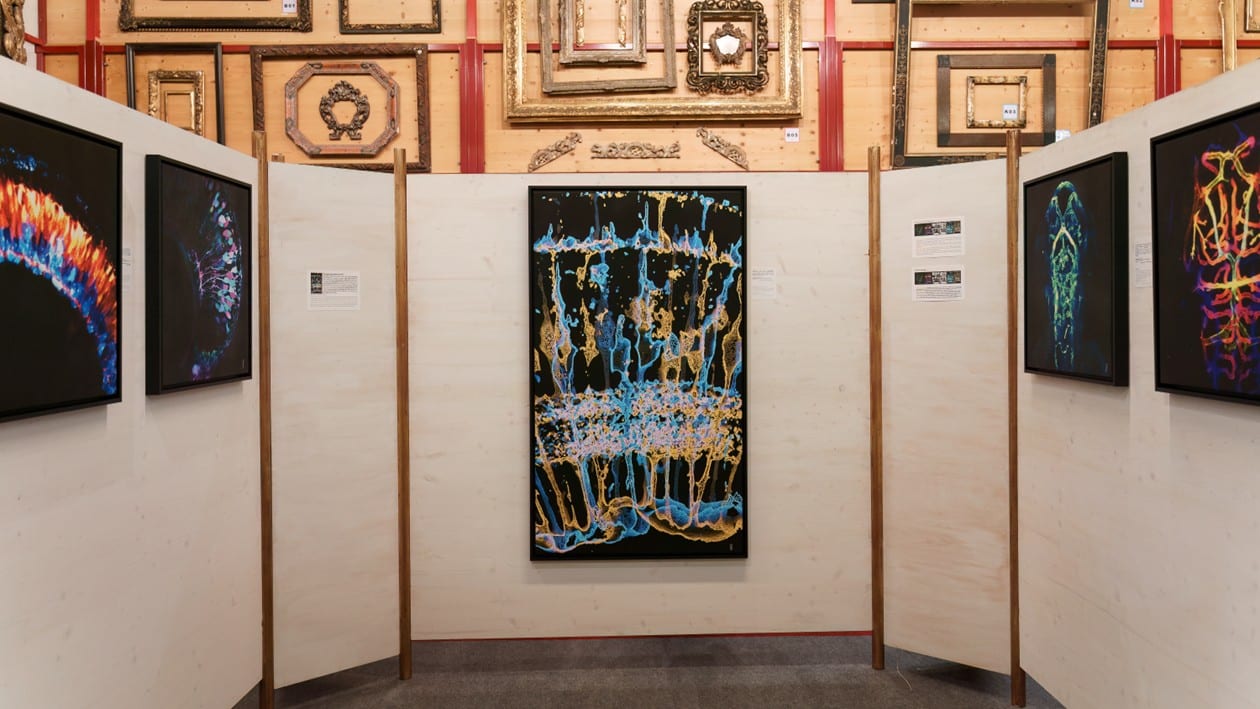
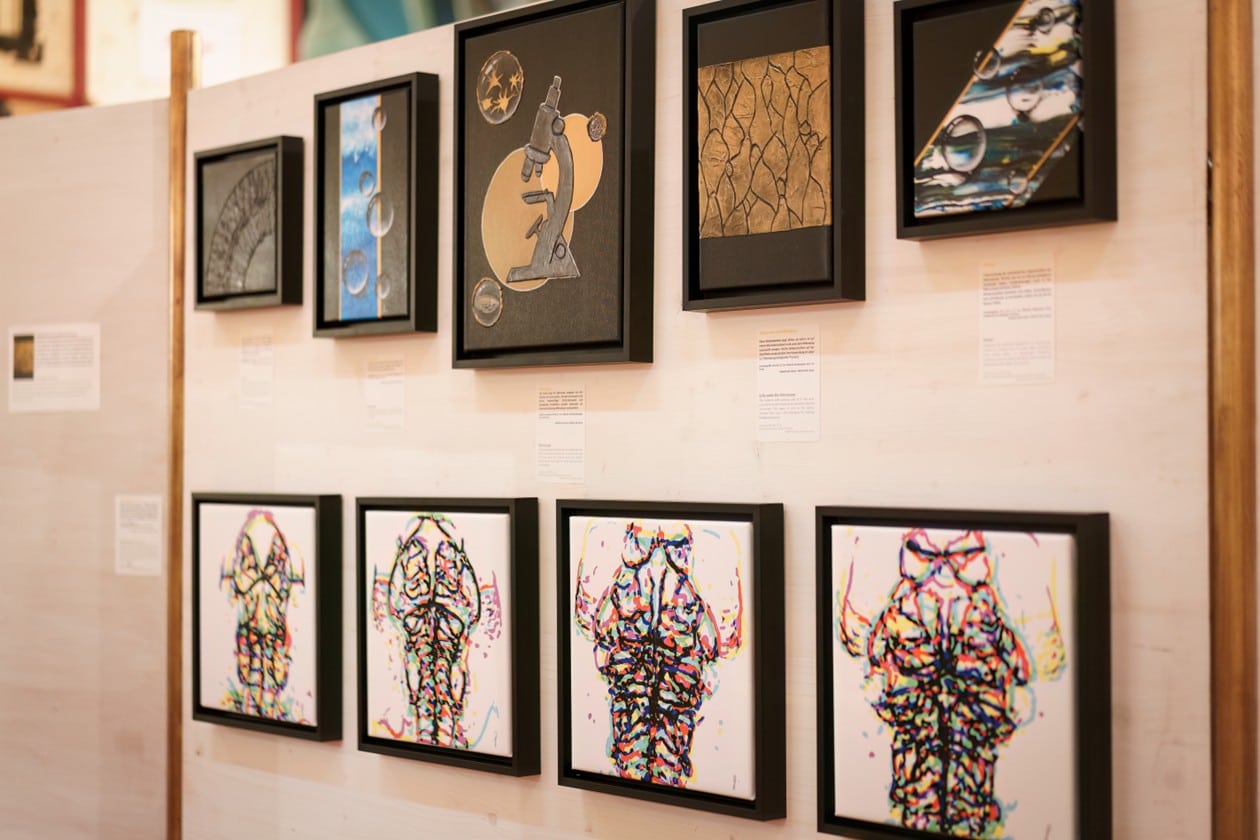
I have always been very ‘arty’ and I love the overlap between science and art. I think I came to SciArt almost subconsciously because there’s so much beauty in data, especially 3D data and microscopy. Getting into SciArt was also a step-by-step approach, starting out with me trying out different lookup tables in Fiji and evolved to a point where I tried to merge science and art. I have used digital art and printed art to help convey science to the general public. We did a science art exhibition in Austria where we had people come in and ask questions about science based on the art. Having the science angle and the art angle means you can talk to anyone, it might be someone saying they like it, or they don’t like it, and that’s fine. Or they might ask, what am I looking at? So, they can lead the conversation to the level they want to go to and I really like this approach to science communication. I think it really helped open new conversations and obviously it’s nice to look at!
How did you come to the decision to start your own company?
I did a postdoc at UCL from 2020 to 2022, but during this time I developed a chronic illness, an autoimmune disease and that meant I could no longer work in the lab. I had to find something different to do to pay the mortgage. I initially interviewed for jobs such sales for microscope companies, but unfortunately, at the time, I was too ill to do any of these jobs. But of course, I still needed to pay the mortgage, and so I decided to build my own company. Initially, we started off doing science art and science illustration for biotech and life science companies, as well as selling the science art that I had made during my PhD and my postdoc. Very quickly, people started asking for other things such as writing copy for a web page or for help with a podcast. It became about communicating science in more ways than just with art – our clients wanted the whole package. That’s how Zeeks grew from doing science illustration and science art to now being a science communication and marketing company. It has been a journey, and it has been interesting and challenging.
When you set up Zeeks, was there anything that was harder than you expected, or anything that ended up being easier than you thought?
Before I started Zeeks I had no idea about business, so I was blissfully naive. Since I didn’t really know what it all entailed, I just took it one step at the time. The great thing was there were so many people out there who were willing to help, and there is lots of training if you know where to look. One big thing that helped me was reaching out to people who had companies that were similar to what I envisaged for Zeeks, and those people were always happy to help – be it via WhatsApp, a short call, or feedback on proposals. This support was essential because suddenly I was working by myself rather than having the support from colleagues in the lab. One big decision that I took right at the beginning of this journey was to start a company rather than being a freelancer.
What are the differences between being a freelancer or setting up a company?
That’s a question I get asked a lot, “should I become a freelancer or start a company?” I think it’s an interesting question, because the mindset is very different between being a freelancer or running a company. At first, it doesn’t really seem like a lot, but as a freelancer you are the business, whereas if you run a company, you run and own the company. So, there’s a very distinct mindset, especially if you think long term, and that’s something that I struggled with at the start. I had started a company, but I thought the company was me. Then, over time, I started to see that I needed to step away and be the director and recognise that the new people coming in and the new projects were the business and not me. For freelancers, that’s different in how you position yourself, and the brand of your business. Even though you’re just one person, you still have a brand. I think that both freelancing and setting up a company have their pluses and minuses, but there are differences in terms of structure, legality, but also psychological, and all of these things are important to think about. It’s possible to change from freelancer to business as things evolve, but it’s more difficult to change from a company to freelance. Overall, I think it’s important to think about what you want to achieve long term, asking how you’d like to scale, your approach to collaboration, and what projects you want to take on. I think it’s important to sit down think about which option suits you best and then make that decision, rather than just diving into one.
It feels like Zeeks has come a long way quite quickly, when did you found the company?
I founded Zeeks after my postdoc. We officially incorporated in August 2022, and we started to work in November or December. So, it has been just a bit over three years, and it feels like a long time! There has been a lot of development and a lot of things happening. But I think the nice thing is that I’ve had a lot of freedom and I have been able to try lots of different things. With a young company, you have the opportunity to try different things and to explore the space you are in. This is harder to do with a more established company. It has been an exciting time to really shape what we are doing going forward.
You’ve spoken about building a team and I saw on your website that you have quite a few people that you’re working with now, how has this evolved?
From the very start, I’ve loved setting up collaborations, because again, I think if you work by yourself, it can be very intimidating and it can be also very lonely. This was particularly true when everyone was working from home after Covid. So, from the start, I tried to collaborate with people, and now we have lots of freelancers that work with us and that partner up with us, or people that we bring on for specific topics, for example, nutrition or biochemistry or regulatory affairs – things that I don’t have the subject matter expertise for. It’s nice to have people come in for different projects and also have a core team of people who have worked with us from the start. And it’s the same with customers, we’ve been really fortunate to have some companies as our customers from day one. And we’ve built those relationships with collaborators and customers over time. I really enjoy this engagement and even though people might be on different continents or working in a different time zone, you are still trying to connect as much as possible.
Could you tell us about some of the projects that you’ve worked on?
So, as I said, we’ve done loads of different things. At Zeeks, we provide strategy, content and training for science marketing and communication. For content, this can include copywriting, illustration and podcasts as a service. Topic-wise, we also cover a wide range of areas. If I have to pick a favourite, I really enjoy podcasting because you get to talk with people behind the scenes and get new insights that you might not get if you write a blog or publish something on a website. We run a podcast called ‘Keep it Science’, together with Dr Nick Gaunt from Acorn Scientific Marketing. In our most recent season, we have focused on rare diseases and it’s been really interesting because, again, I myself have a rare disease. I’ve enjoyed bringing together that scientific and patient expertise, so this season we’ve worked with charities, clinicians and patients. We’ve also been on BBC Radio and the BBC Radio Christmas special. It has been good to explore the different opportunities that arise from our work.
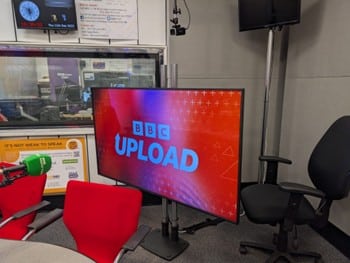
I’ve also worked with microscope companies and hosted other podcasts like Conversations on AFM or The Light-sheet Chronicles with Bruker. These are more technical podcasts, but as well as covering the maths of microscopes, we also talk about the applications and the research that researchers are using it for. It’s the storytelling that makes podcasts interesting, whether this is how people solved a problem in the lab, how they developed a new algorithm or how to deal with data.
Do you have a typical day, and if so, what does it look like?
I like to have lots of different projects on the go, so I don’t really have a typical day. I think if you’re a small company, you do a bit of everything. You do the accounting, the project management and the social media. You have your hands in everything, which makes it interesting, but you do need to be very strict with your time. I also have to make sure that I’m looking after my health, so I have to be very strict about when I work and how I manage my treatments. At the moment, there are certain days when I’m doing more customer work then and others where I might be doing the overhead things. This flexible approach has allowed me to experiment with different projects, different topics and different customers. Maybe in three or four years, as the business grows, I’ll have a typical day!
Are you still doing illustrations yourself?
Yes, absolutely, especially for the optics and microscopy side of things. The science and art side has probably taken a step back in terms of what the company is doing, but it is a service that we offer.
You’ve talked about reaching out to other people for advice and I was wondering, do you have any tips from your own experience for someone trying to set up their own company?
One of the main things is, again, to reach out to people you know to ask your questions. It’s important to remember that we all have different backgrounds, so there are no stupid questions. And as I mentioned, there is a lot of free training for small businesses and startups available, especially in the UK. There’s a web page that’s called DigitalBoost, or there is training from the British Library, and also from NatWest.
I think the biggest step is always the first one, because that’s a scary one, right? For example, registering a company, and that can be really scary. And then you take the next step, for example, applying for a bank account. And you start to build up these little steps and over time, it just becomes easier. Sending my first invoice was another big step, because it all felt so official, especially as it was an international invoice and meant knowing about international taxation. Again no one can know everything, it’s important to ask for help, you can ask an accountant, you can ask a lawyer, you can ask a banker. I think imposter syndrome is also very common for business owners, but as scientists, I think we have a learning mindset and we are used to solving problems or being challenged. It’s good to systemise things, and approach things step by step-by-step, so I think, as a scientist, you already have an advantage when setting up a business.
How do you go about working out a fee for a project and what happens as the project evolves?
That’s a good question, and it comes up a lot in the peer mentoring discussions that I have participated in. In our field, we have something called scope creep, which is where you have a contract, but then customers ask for more and more. Obviously, that is something that you want to avoid and one way to do that is by building relationships with your customers. When working with new customers it is important to have a clear outline of what you’re going to do, how you’re going to work and how often you’ll check in. When we write an estimate for a three-month project with someone, we’ll make a timeline showing what we’ll be doing each month, when we meet and how the project will be set out. If it’s a non-retainer project, we use a rule of thumb of “one big and one small revision”. If someone comes back multiple times and asking for revisions or additional things, we always have to say that while we can do the work, we’ll have to take some time from another part of the project (for example, if we have to go back into a project 9 times to change the font, export, update files, and share with stakeholder, this takes time away from other things). It is important to be open, and most customers are absolutely understanding. For pricing, I always like to think of the ‘triple constraint’ triangle: Work can be fast, it can be cheap, or it can be to the highest standard, but not all three of those things at the same time. For example, if someone asks me on a Friday for some work to be delivered by Monday, then it will be more expensive, and the quality will probably not be as good, because it needs to be super-fast, there is little time for creativity, planning, revision, or input. But if you say to me, you only need this done in three months, then it’ll be of great quality, and it’ll probably be cheaper. It is important to be protective of your time because it is such a precious commodity, and sometimes we need to educate customers on how we work. While I can be flexible with timings, I love working in advance!
You’ve been recognized with a few awards with Zeeks already, can you tell us about them?
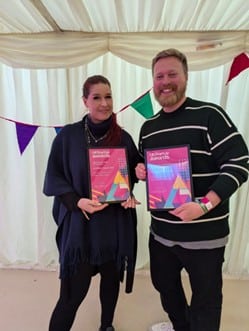
We’ve won a creative StartUp Award in 2024, and our podcast ‘Keep it Science’ has been shortlisted for some science communication awards and was in the Top5 BBC Uploads of 2025. It’s been nice to be recognised, especially because it’s all in the creative space, and it’s all about science communication. I like to stay in touch with that side of the business as we’ve been doing more marketing and commercial work. The ‘Keep it Science’ podcast is about talking to the general public and showing that science isn’t dry. It’s not just protocols, white lab coats and maths; we showcase that science is exciting, and everyone can do science.
What’s next for you and for Zeeks?
Like I’ve said, we’ve done lots of experimenting in our first three years, but now it is the time to streamline and become more focused on the things that we’re really good at and that we found really work. This includes looking after these long-term relationships with our partners and customers, to really build on these and strengthen our network. As we become more coherent as a company, we’ll be ready to scale to the next level and see where it takes us. Of course, as a small company the fact that we’ve survived for three years is great (70-90% of UK startups stop after 2-5 years)!
Are you able to take on new clients and if so, how can they reach out to you?
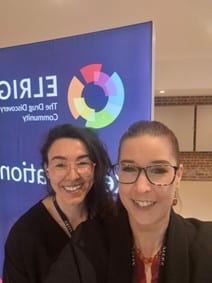
Yes, we love talking to people, whether it is new clients or for a collaboration. People can reach us on our website or by connecting with me on LinkedIn.
Congratulations on all you have achieved with Zeeks so far, it’s really impressive and has been exciting to see. Thanks for sharing your insights with us.
Get involved
Create an account or log in to post your story on FocalPlane.
More posts like this

Filter by
- NewsApply
- DiscussionsApply
- How toApply
- ToolsApply
- Case studiesApply
- InterviewsApply
- JobsApply
- EducationApply
- Blog seriesApply
- Volume EMApply
- Latin American Micro..scopistsApply
- Bio-image Analysis w..ith NapariApply
- Imaging with…Apply
- Towards Global Acces..sApply
- Latin America Bioima..gingApply
- From Zero to Qupath ..HeroApply
- Asian Microscopists ..and Cell BiologistsApply
- AIC at HHMI JaneliaApply
- Deep Learning for Bi..o-image analysisApply
- GloBIAS – updates fr..om the communityApply
- WAMBIAN: West Africa.. in FocusApply
- Highlights from Euro..-BioImagingApply
- LSFM seriesApply
- DIY MicroscopyApply
- View all