

Imaging spotlight: Volumetric Imaging via Photochemical Sectioning (VIPS)
Posted by FocalPlane, on 2 December 2025
In this paper highlight, we learn more about VIPS, a method developed by Srigokul Upadhyayula, Ruixuan Gao and colleagues.
Can you briefly describe your new technique?
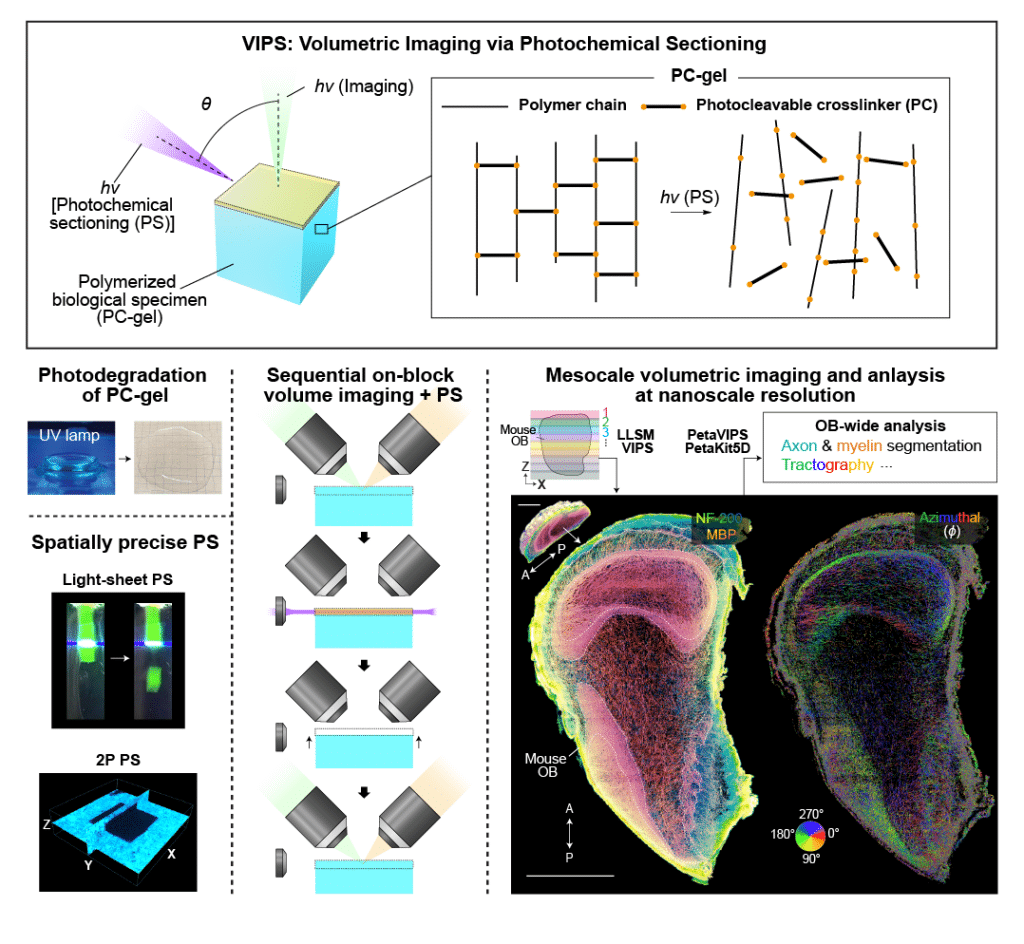
VIPS integrates on-block optical imaging with a non-contact sample sectioning process termed photochemical sectioning. This approach achieves spatially precise sample slicing or removal through light-induced photochemical degradation. VIPS requires embedding biological specimens (e.g., intact cells and tissues) within a hydrogel synthesized with a photocleavable cross-linker (“PC-gel”). Illumination by a focused point, line, or sheet of light then photocleaves the polymer network, effectively solubilizing the exposed volume.
How has VIPS been used for so far?
VIPS has been successfully implemented on existing microscopes to enable continuous, automated acquisition. This allows for nanoscale fluorescence imaging of whole-mount specimens of virtually unlimited size, restricted only by the dimensions of the microscope’s sample chamber and translation stages. In our recent demonstration, we combined serial photochemical sectioning with on-block lattice light-sheet microscopy to reconstruct axons and myelin sheaths across entire mouse olfactory bulbs, successfully generating petabyte-scale datasets at nanoscale resolution.
Who should use VIPS and what other fields could it be applied to?
VIPS is applicable for researchers seeking to scale super-resolution volumetric optical imaging to large whole-mount tissues, such as mammalian brains and regions thereof. Furthermore, VIPS can be effectively applied to 3D histology and pathology.
What do researchers need to implement VIPS?
Photochemical sectioning can be performed using either a single-photon or a multiphoton process. Consequently, VIPS is compatible with various optical setups to achieve sectioning, including a two-photon point-scanning system or a single-photon light-sheet illumination.
What are the requirements for further development?
Two primary needs for advancing VIPS include: First, computational resources and AI systems capable of analyzing and interpreting the resulting massive datasets; Second, a robust homogeneous and dense labeling strategy suitable for increasingly larger whole-mount tissues.
Where can people find more information?
Additional experimental procedures and imaging results can be found in our recent publication about VIPS: https://doi.org/10.1126/science.adr9109
 (No Ratings Yet)
Get involved
Create an account or log in to post your story on FocalPlane.
More posts like this


Filter by
- NewsApply
- DiscussionsApply
- How toApply
- ToolsApply
- Case studiesApply
- InterviewsApply
- JobsApply
- EducationApply
- Blog seriesApply
- From Zero to Qupath ..HeroApply
- Asian Microscopists ..and Cell BiologistsApply
- AIC at HHMI JaneliaApply
- Deep Learning for Bi..o-image analysisApply
- GloBIAS – updates fr..om the communityApply
- Volume EMApply
- Latin American Micro..scopistsApply
- Bio-image Analysis w..ith NapariApply
- Imaging with…Apply
- Towards Global Acces..sApply
- Latin America Bioima..gingApply
- Highlights from Euro..-BioImagingApply
- LSFM seriesApply
- DIY MicroscopyApply
- View all