

Epithelial Mechanics Fan Club
Posted by FocalPlane, on 4 December 2025
In this post, Nimesh Chahare and Julia Eckert tell us about the ‘Epithelial Mechanics Fan Club’. You can follow the club on Bluesky, X, and now on their new website. Reach out to Nimesh and Julia if you would like to contribute.
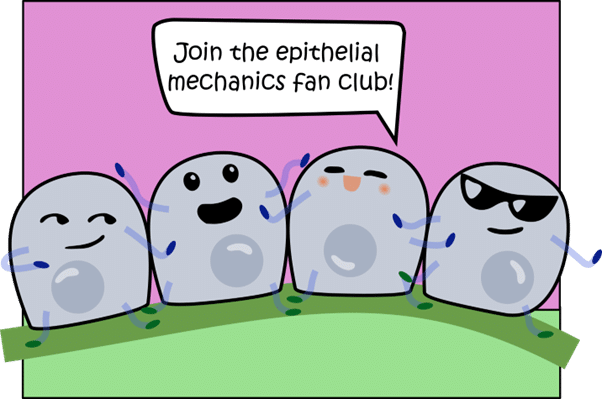
Epithelial cells play a crucial role in development and homeostasis, with many of these processes regulated by physical forces across various lengths and timescales. In recent years, the burgeoning field of “Epithelial Mechanics” has gained traction worldwide, prompting researchers to ask pivotal questions: What physical principles govern biological processes? How do cells generate and respond to mechanical forces? How can we measure the forces exerted by cells, and what techniques can we use to study these mechanical properties? Through the Epithelial Mechanics Fan Club, we focus on this fascinating topic by informing our community about newly published articles and summarizing key topics in the form of mini-review threads, written by passionate early-career researchers (ECRs).
Meet Nimesh – Starting Epithelial Mechanics Fan Club

My name is Nimesh Chahare, and I am the convenor of the club. During my PhD at the Trepat lab in IBEC Barcelona, I studied the role of pressure and geometry in epithelial morphogenesis in vitro. Now, as a postdoc in the Nerurkar lab at Columbia University, I am exploring similar questions in vivo in the neural tube. As a mechanical engineer, I find the role of mechanics in biology very interesting.
In early 2023, writing my PhD thesis introduction made me more excited about science and epithelial mechanics than ever. I think I wrote a bit too long of an introduction for my PhD thesis, but hey, it works! I’ve packed in five references for nearly every niche in epithelial mechanics. Want to know how curvature affects tissues? I’ve got papers for that! Curious about epithelial buckling? Yep, five more! At the time, #ScienceTwitter was buzzing with researchers sharing threads that summarized their papers. There were also field-specific accounts like Zebrafish Rock! and soft/living matter fanclub. I loved those threads and thought, “Why not do the same for epithelial mechanics?” As an epithelial mechanics fan, on July 23rd, 2023, I decided to start the Epithelial Mechanics Fan Club. I thought it would be straightforward: my plan was to share one research paper every day and, in between, provide mini-reviews of specific topics through threads. Like this one about hydraulic fracture.
I started building an online space for fans of epithelial mechanics, but I faced typical social media issues like having no followers and feeling anxious about engagement, which made me constantly check my notifications. Eventually, I saw it as a science communication project and developed better habits for managing the account. I could write threads myself, but it felt more like a community when others joined in. So, I started asking my labmates and other researchers I met to contribute threads. I call these contributors “delegates”. Posting a paper a day and finding scientists eager to write for you may sound easy, but trust me, it’s not! I needed help managing the club and wanted someone who shared my excitement. Julia had written a super popular thread for us, so I reached out to her, and thankfully, she was totally in!
Meet Julia – Joining the Team
I am Julia Eckert, a DFG Walter Benjamin Fellow / postdoctoral researcher, working as an experimental biophysicist in Alpha Yap’s lab in Brisbane, Australia. After posting my first thread about tissue nematics through the Epithelial Mechanics Fan Club in January 2024, I am now organizing this amazing platform together with Nimesh. Like Nimesh, I dedicated my PhD, which I completed at the Leiden University in the Netherlands, to the fascinating field of epithelial mechanics. During my PhD, I measured forces exerted by cells on substrates, investigated how they organize within tissues, and correlated these observations with theoretical simulations. To understand the mechanobiological mechanisms underlying these physical properties of cells and tissues, my journey has brought me to Australia, where I now investigate morphogenetic events in three-dimensional tissues by combining experimental biology and soft matter physics, leveraging my expertise in image analysis.
When Nimesh contacted me to join the club as an organizer, I saw it as a great opportunity to stay in contact with the European scientific community. And, hey, building a global network of young researchers interested in epithelial mechanics was just an amazing idea! Nimesh and I only knew each other from an EMBL conference in Heidelberg in 2022, but since we share the same passion for science and dedication for the club, we have become good friends working on opposite sides of the world and this has enabled us to manage the club smoothly.
Growing the Epithelial Mechanics Community
Over the years, we have established a rhythm where we share old and new papers daily and mini-review threads every two to three weeks. In particular, our mini-review threads are outstanding and form the heart of our club. These are contributions from ECRs—ranging from undergrad students to postdocs—and cover diverse areas, including biophysics, developmental biology, theoretical physics, and molecular biology. We would like to take this opportunity here to acknowledge all our delegates for their contribution! Typically, our delegates’ threads contain 4-5 research papers and one review paper, and are summaries of their research areas, including recently published papers or showcasing work from their labs. For example, we have threads on intermediate filaments, cell competition and extrusion, symmetry breaking, cell and tissue migration, as well as in vitro and in vivo measurement tools. However, many topics are still missing, such as mechanotransduction and signaling pathways, intercalation, and tissue elongation in vivo. Additionally, some topics may need to be updated, including the effect of curvature, stress inference methods, and cell-cell contact, to keep up with the latest publications. If anyone is working in these areas and would like to tick the subject, we are more than happy to follow up on this.
We are constantly looking for new delegates to share their passion for #EpithelialMechanics. And honestly, it is not that much work—just know five papers about your favorite epithelial mechanics topic. If you are interested, please reach out to us!
Website: https://epithelialmechanics.github.io/contact/
Bluesky: https://bsky.app/profile/epimechfc.bsky.social
Typically, we reach out to researchers worldwide after they share new preprints or papers on social media, inviting them to write threads for our community. This process became easier as our follower count steadily increased, especially first on X (formerly Twitter), where we hit more than 2100 followers after the first year. Reaching this first milestone motivated us to declare July 23rd as International Epithelial Mechanics Day in recognition of the researchers working in this field. However, like many others, we faced the transition to a new platform, Bluesky, late last year. This shift temporarily slowed our momentum, and we needed a little time to reconnect with our community. In particular, this event, and along with the realization that not everyone continued to use social media, inspired us to create a dedicated website. With our website, we aim to ensure the stability and growth of our network, while acknowledging and increasing the visibility for our past and future delegates and their threads.
After a little more than two years, we are still experiencing significant growth and gaining thousands of followers. Even more, the initial idea of creating a platform of resources in #EpithelialMechanics has evolved into a steadily expanding platform where ECRs share their favorite research topics, interest, or lab focuses. These contributions have made a significant impact. For example, we have received feedback indicating that our threads are used for lecturing purposes at universities. We are particularly happy to hear that this platform has facilitated collaborations among ECRs by connecting groups with the desired tools and expertise, but has also supported some in finding their next academic position.
Looking ahead, we are excited about potential future initiatives, including conferences, workshops, and a seminar series dedicated to #EpithelialMechanics. Our vision is to foster knowledge exchange and enhance the visibility of individual research topics, encourage fruitful discussions and collaborations among young experts, and support the development of individual careers—but also strengthen the community as a whole. We invite you to be a part of this exciting journey. Share your story, connect with us, and stay tuned for updates on our website. Together, we can shape the future of #EpithelialMechanics!
 (1 votes, average: 1.00 out of 1)
Get involved
Create an account or log in to post your story on FocalPlane.
More posts like this

Filter by
- NewsApply
- DiscussionsApply
- How toApply
- ToolsApply
- Case studiesApply
- InterviewsApply
- JobsApply
- EducationApply
- Blog seriesApply
- Volume EMApply
- Latin American Micro..scopistsApply
- Bio-image Analysis w..ith NapariApply
- Imaging with…Apply
- Towards Global Acces..sApply
- Latin America Bioima..gingApply
- From Zero to Qupath ..HeroApply
- Asian Microscopists ..and Cell BiologistsApply
- AIC at HHMI JaneliaApply
- Deep Learning for Bi..o-image analysisApply
- GloBIAS – updates fr..om the communityApply
- Highlights from Euro..-BioImagingApply
- LSFM seriesApply
- DIY MicroscopyApply
- View all