

Featured image with Ioannis Theodorou
Posted by FocalPlane, on 27 February 2026
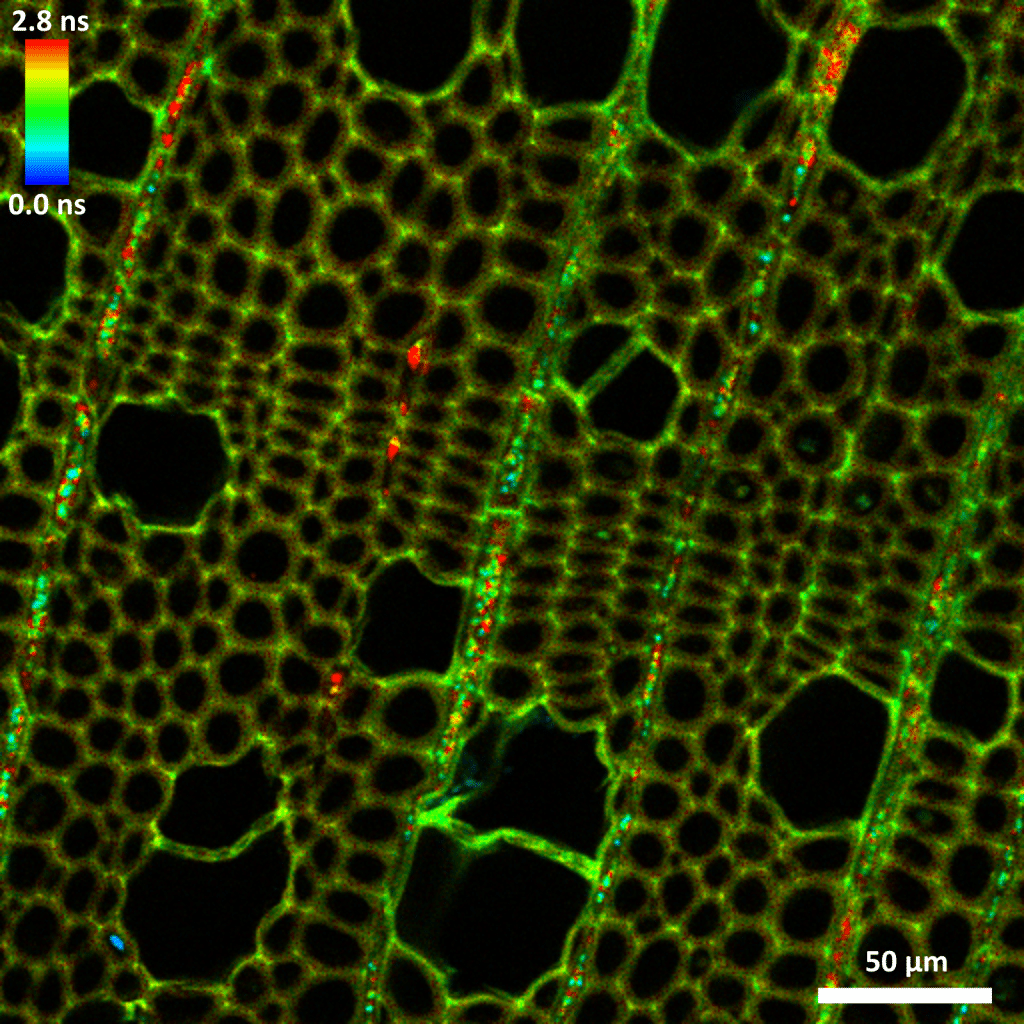
Our featured image, from Ioannis Theodorou, was acquired with Leica Stellaris 8 and the TauSeparation mode. It is the TauContrast channel and it shows the average fluorophore lifetime per pixel. The image was processed on Las X and inkscape. The region shown comes from compressed wood tissue.
Discover more about Ioannis’s research.
Research career so far: I completed my PhD in France and the lab of Benedicte Charrier, focusing on tissue patterning and morphogenesis during the embryogenesis of Saccharina latissima. My first research paper was actually published in Development (https://journals.biologists.com/dev/article/150/21/dev201519/334165/The-shift-to-3D-growth-during-embryogenesis-of) and our image was selected for the cover, so, I feel a special attachment to the journal.
Current research: I am in my 3rd year as postdoctoral researcher at Umeå Plant Science Centre (UPSC) working on the cell fate patterning and mechanics in different plant systems, specifically Poplar wood tissue and Arabidopsis thaliana root meristem.
Favourite imaging technique: I am learning how to use different FLIM methods, mostly on a structural level, looking at whether wood tissue composition is affected by mechanical stress (lignin wise). I started working with FLIM microscopy, and more specifically the TauSense from Stellaris, quite recently so I’m biased on which microscope or technique I consider my favourite. I currently favour the Leica Stellaris 8 and the TauSense over the Zeiss 880 + Picoquant for the easy access to image data with lots of analytical information. However, the Picoquant system that we have in UPSC is a very strong analytical tool.
What are you most excited about in microscopy? I am excited seeing how AI is implemented in acquisitions and image analysis from ‘clever’ tracking systems and denoising to produce high resolution microscopy images to classification of cell types (e.g. https://doi.org/10.1016/j.eng.2025.08.005 , https://doi.org/10.1038/s41592-025-02871-4 , https://doi.org/10.1038/s41598-024-60916-8). Also, I’m interested in how community has embraced the LLM models to create, for instance, chatbots that can help you learn and test different image analysis approaches (https://doi.org/10.1038/s41592-024-02370-y).
 (3 votes, average: 1.00 out of 1)