

Imaging with… ADMiRA
Posted by FocalPlane, on 16 March 2026
In our ‘Imaging with…’ blog post, we meet the team at ADMiRA, the Advanced Microscopy Applications Unit at the National Cancer Institute in Mexico City.
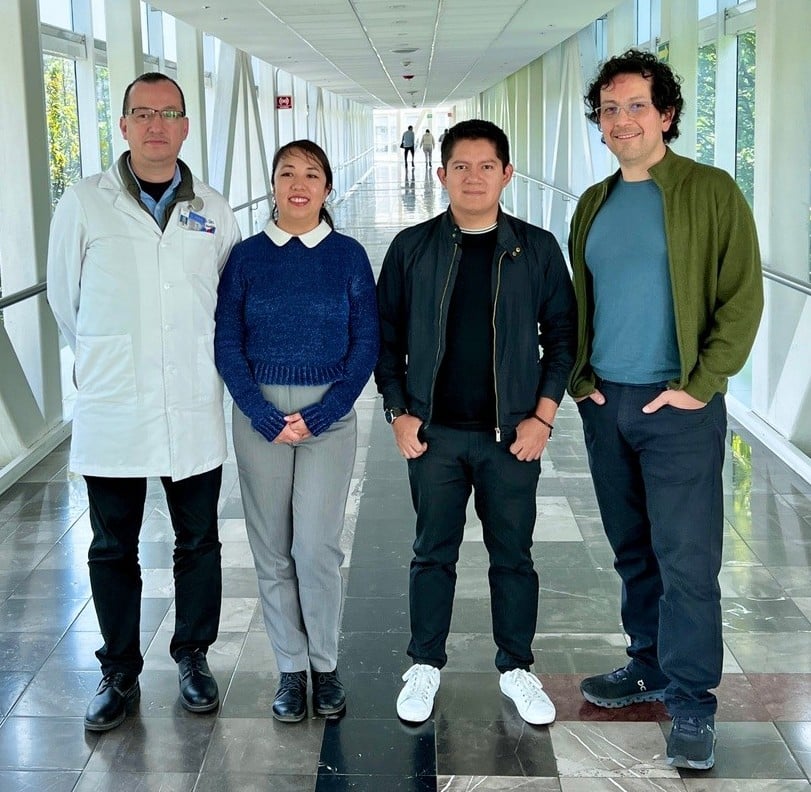
Staff role call
Aquetzalli Marina Arenas Hernández, Msc (Marina), Microscopy specialist and molecular biologist
Expertise:Operation of equipment, mainly electron and widefield microscopy. User training. Sample preparation for widefield and expansion microscopy.
Most likely to be foundsupporting users for imaging acquisition, either in widefield microscopes or in the STEM microscope. Supporting experiments involving molecular biology techniques or sample preparation for expansion microscopy. Also, sitting in front of a microscope computer, wrapped in a blanket to survive the cold, or opening a door for a user who needs access.
Best bit of advice (that you give or have been given): If you ever lose focus, go back to low magnification and start again. You’ll waste far less time than trying to refocus at high magnification.
Fernando Luna Maldonado, PhD (Fer), Microscopy specialist and molecular biologist
Expertise:Operation of equipment, mainly laser microdissection and confocal microscope. User training on those techniques, cell culture and molecular biology. Sample preparation for widefield and expansion microscopy.
Most likely to be found everywhere in the unit where there is a microscope, and in the lab running experiments and preparing samples for imaging, always accompanied by music.
Best bit of advice (that you give or have been given): Clearly define the question you want to answer, choose the best tool to address it, and get to work. There are many microscopy techniques that can help you, but don’t get lost trying to use all of them. And never work while exhausted—you can easily ruin days of work that way.
Carlo César Cortés González, PhD (Carlo), Microscopy specialist and histologist
Expertise:Operation of equipment, mainly the automated whole-slide scanner. Preparation of samples for that microscope and also for brightfield and fluorescence microscopy.
Most likely to be found planning and executing new scientific projects – while supporting users with microscopy workflows.
Best bit of advice (that you give or have been given): Spend more time on the sample than on the acquisition. Microscopes don’t fix biology—good prep does.
Alejandro López Saavedra, PhD (Alex), Microscopy specialist, core facility manger, researcher on medical sciences.
Expertise: Operation of equipment, mainly confocal, super-resolution and light-sheet microscopes. User training on those microscopes, sample prep, image processing and analysis, and biology of cancer.
Most likely to be elsewhere in the core facility, operating either the confocal, the super-resolution, or the light-sheet microscopes, providing services, guiding visitors, making calls to services providers to solve problems in the facility (power cuts, malfunctions of microscopes or air conditioning systems, etc). At the office, attending and guiding users requesting microscopy for their projects, writing grants, papers, meeting with researchers, preparing classes for the university, replying tons of emails ….
Best bit of advice (that you give or have been given): Always recognize your limitations, make questions, respect, value and consider everyone’s opinion and expertise, make them feel important in the team and always acknowledge and reward their contributions.
Microscope role call
Confocal, multiphoton & live-cell microscopy
High-resolution optical sectioning for fixed and live samples. Supports FRET, FRAP, spectral unmixing, and deep-tissue imaging via multiphoton excitation—ideal for dynamic cellular and molecular studies.
Super-Resolution microscopy (SIM, PALM), TIRF & CLEM
Breaks the diffraction limit to visualize nanoscale structures. SIM offers fast super-resolution; PALM provides single-molecule localization; TIRF excels at membrane-proximal events; CLEM links fluorescence with ultrastructure.
Laser microdissection & micromanipulation through optical tweezers
Precise isolation of cells or tissue regions for downstream genomics, transcriptomics, or proteomics, enabling spatially resolved molecular analysis.
Automated scanning of mitotic cells & karyotyping
High-throughput detection and analysis of mitotic figures and automated karyogram generation, commonly used in cytogenetics and clinical diagnostics.
Two inverted microscopes (brightfield, phase contrast, DIC, fluorescence, live-cell)
Versatile platforms for routine cell culture, morphology, and fluorescence imaging with environmental control for live-cell experiments.
Two upright microscopes (brightfield, phase contrast, fluorescence, dark field)
Flexible contrast modalities for diverse specimen types, including unstained or weakly scattering samples.
Whole-slide digital scanning (Automated slide scanner)
High-resolution digitization of entire slides for digital pathology, image analysis, AI workflows.
Light-sheet fluorescence microscopy (LSFM)
Rapid, low-phototoxic 3D imaging of large cleared samples and organoids—ideal for volumetric reconstruction and quantitative tissue analysis.
Electron microscopy (SEM, TEM/STEM, FIB & CLEM)
Ultrastructural imaging at nanometer resolution. SEM/TEM/STEM for surface and internal structures; FIB for site-specific milling; CLEM bridges fluorescence and EM.
Stereomicroscope (brightfield & fluorescence)
Low-magnification, large-working-distance imaging for dissection, screening, and sample preparation.
Pet peeve (something that users do that is annoying): When users urgently request to schedule a session as soon as possible—only to show up late because “something came up”— . Also, when they don’t clean their slides prior imaging. When they apply way too much mounting medium, leaving everything sticky and difficult to clean (even though we explicitly ask them to clean it themselves), and finally rush the sample preparation… only to ask why the image doesn’t look like the high-quality figure from the paper they saw last week.
Favourite microscope: Difficult question… everyone has their own favourite microscope. Marina likes the electron microscope because it allows her to see in far more detail, although she also misses seeing colors of the photonic microscopes. Fer likes the microdissector, but he also is keen on the super-resolution microscope. Carlo says that all microscopes are important but he argues that we all have been fighting for the same one – his automated slide scanner… (because currently we have several projects using this microscope). I also like them all, but personally, I prefer the simplest, less technified, oldest ones.
Favourite thing to image (Alex): My favourite thing to image is biological samples—especially chromosomes, 3D samples labeled with fluorophores, and beautiful whole tissue sections where the staining, structure, and resolution all come together and the biology just makes sense (honestly, way more interesting than synthetic samples).
If money was no object, we’d invest in the latest technologies—including a Cryo-EM system and a fully automated, top-tier digital pathology setup—along with lifetime/most complete service and maintenance contracts for all our equipment (and even the air conditioning system), plus permanent staff contracts and unlimited training in new applications, techniques, and image processing for both the team and our users.
Who can access the facility?
Anyone. The users should contact the facility first, fill out a registration form, discuss the project and make an appointment to enter into the facility, either to be trained or have us imaging their samples. We have also been sent samples from different locations. We constantly receive visitors, mainly students, even children, for whom we provide guided tours.
Can you give us some examples of recent papers that were published with your assistance?
Protocol for induction and study of DNA double-strand breaks in mammalian cells using PALM microdissection and expansion microscopy
STAR Protocols,Volume 6, Issue 3,2025, https://doi.org/10.1016/j.xpro.2025.103938
This paper presents a validated protocol to induce localized DNA double-strand breaks using laser microirradiation and to visualize DNA damage and repair proteins at nanometric resolution using expansion microscopy. It provides step-by-step guidance from sample preparation to quantitative image analysis, enabling high-resolution study of the DNA damage response with standard confocal microscopes. The protocol was developed within ADMiRA core facility and the importance of this is that the facility becomes a knowledge hub, not just an equipment provider, and thus generates academic value and visibility through shared methodologies. At the same time, users gain access to cutting-edge methods without needing expensive super-resolution systems, and since the method was already standardized at home, the experiments become more reproducible, standardized, and reliable across other user’s projects.
Another beautiful example is the paper:
Large-scale topological disruption of chromosome territories 9 and 22 is associated with nonresponse to treatment in CML. Int. J. Cancer. 2022; 150(9): 1455-1470. doi:10.1002/ijc.33903
It shows that super-resolution microscopy (3D-SIM) can reveal large-scale disruptions in chromosome territories 9 and 22 in Chronic Myeloid Leukemia patients who do not respond to the standard therapy, linking nuclear architecture with treatment resistance. The authors demonstrate that super-resolution imaging is not only useful for molecular or structural biology, but can also uncover clinically relevant biomarkers and prognostic features. For imaging facilities like ADMiRA, the results highlight the strategic role of integrating super-resolution platforms into translational research, supporting clinicians with cutting-edge tools to improve diagnosis, prognosis, and personalized treatment for cancer patients in our institution.
How should users acknowledge the facility and why is it important?
We ask our users to recognize our facility in the acknowledgement section of any paper and other academic products (thesis reports, poster sessions, conference, etc) as follows:
Instituto Nacional de Cancerología – Advanced Microscopy Applications Unit (ADMiRA), RRID:SCR_026170. https://admiramicro.com.mx
The importance lies in increasing our visibility, both national and international wide and earning recognition from our institutional authorities, so that they fully acknowledge the facility’s impact on advancing science and medicine in our region. This recognition could also encourage them to invest in comprehensive maintenance contracts and provide greater job stability for the staff.
 (2 votes, average: 1.00 out of 1)
Get involved
Create an account or log in to post your story on FocalPlane.
More posts like this

Filter by
- NewsApply
- DiscussionsApply
- How toApply
- ToolsApply
- Case studiesApply
- InterviewsApply
- JobsApply
- EducationApply
- Blog seriesApply
- Deep Learning for Bi..o-image analysisApply
- GloBIAS – updates fr..om the communityApply
- Volume EMApply
- Latin American Micro..scopistsApply
- Bio-image Analysis w..ith NapariApply
- Imaging with…Apply
- Towards Global Acces..sApply
- Latin America Bioima..gingApply
- From Zero to Qupath ..HeroApply
- Asian Microscopists ..and Cell BiologistsApply
- AIC at HHMI JaneliaApply
- Highlights from Euro..-BioImagingApply
- LSFM seriesApply
- DIY MicroscopyApply
- View all