

New webinar series on plant imaging
Posted by FocalPlane, on 30 March 2026
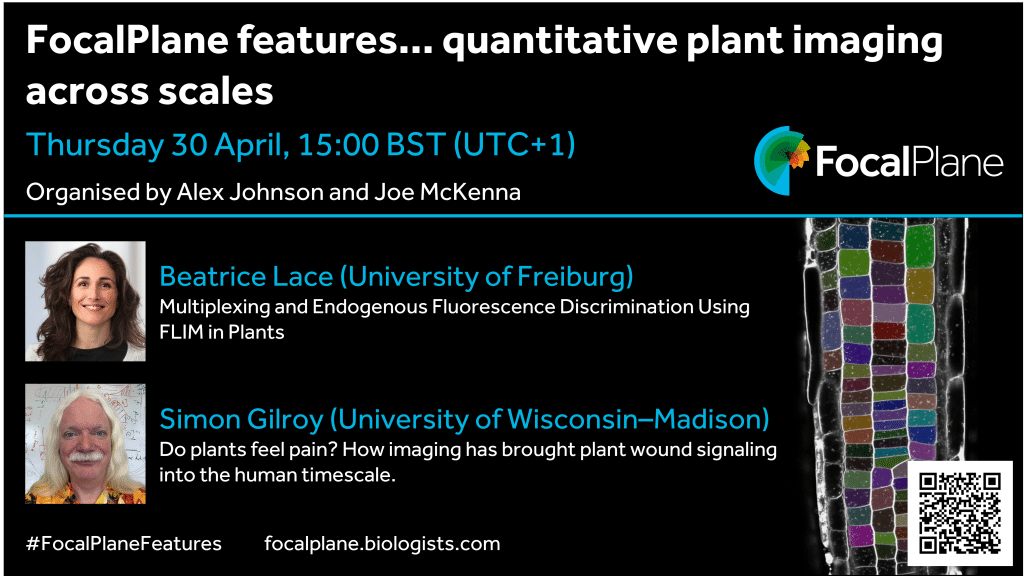
To build on the momentum of our recent Workshop, Macro to micro: quantitative plant imaging across scales, we are launching a new webinar series together with Workshop organisers Alex Johnson (University of Exeter) and Joe McKenna (Warwick University). We’ll be hosting quarterly webinars allowing researchers from all career stages to showcase their research on plant imaging. In our first webinar, we’ll hear talks from Beatrice Lace (University of Freiburg) and Simon Gilroy (University of Wisconsin–Madison).
The goal of the series is to bring together researchers working at different scales to begin understanding how we can integrate them to generate holistic understanding of plant biology from the single molecule to whole plants. We will also invite speakers from outside the plant fields to enable cross model knowledge and technical exchange.
Our next webinars will be at the end July and the end of October and we’d love to hear from researchers that would like to share their research with the community.
Beatrice Lace, University of Freiburg
Multiplexing and Endogenous Fluorescence Discrimination Using FLIM in Plants
High-resolution imaging of multiple fluorescent proteins and markers is crucial for the understanding of biological processes, but it is often limited by the spectral properties of fluorophores and the confounding effect of the autofluorescence. Fluorescence Lifetime Imaging Microscopy (FLIM) overcomes these limitations by measuring an inherent property of fluorescent species – the lifetime. The Phasor approach further provides a rapid and intuitive method to represent and analyse lifetime data, allowing the resolution of complex fluorescent signals and multiple species within a single pixel while maintaining spatial information.
Over the last years, we have established a workflow to conduct lifetime imaging in plants, where this technology has not been exploited extensively yet, including the downstream analysis using the Phasor method. In this seminar, I will present how spectrally overlapping fluorescent reporters can be resolved across different spatial relationship – from segregation to co-localization – enabling multicolor lifetime imaging with subcellular resolution. Extending the Phasor analysis to the endogenous fluorescence of plant cell walls, I will show how we can characterize specific lifetime signatures exemplified by lignin depositions occurring at different domains in plant roots, as a potential label-free approach to identify phenotypes. Finally, I will demonstrate how we employ lifetime imaging to understand the mechanisms of plant host cell remodelling during intracellular symbiotic colonization.
Simon Gilroy, University of Wisconsin–Madison
Do plants feel pain? How imaging has brought plant wound signaling into the human timescale.
Plants possess sophisticated systems that convert local stress perception into whole‑plant adaptive responses. Mechanical wounding or insect herbivory rapidly triggers jasmonic acid (JA) production at the damaged site, but JA also accumulates within minutes in distant, unwounded leaves. Recent imaging approaches are beginning to reveal the molecular mechanisms that enable such rapid systemic communication.
Using Arabidopsis expressing GFP-based Ca²⁺ biosensors the plant-wide dynamics of cytosolic Ca²⁺ dynamics can be visualized following localized damage. Both mechanical wounding and herbivory cause an immediate Ca²⁺ increase at the wound site, followed by Ca²⁺ waves that traveled through the phloem and reache specific distal leaves within 1–2 minutes. These Ca²⁺‑responsive leaves rapidly accumulated JA/JA‑Ile and activated preemptive defense responses, whereas non‑target leaves showed no such changes.
Analyses of responses in a suite of signaling-related mutants has revealed distinct channel families shaping these signals: glutamate receptor‑like (GLR) Ca²⁺ channels play central roles in the rapid transmission of Ca²⁺ waves between organs, while cyclic nucleotide-gated channels (CNGCs) are required for spreading downstream responses within the receiving leaf. Roots also exhibited rapid systemic signaling, with root-to-shoot communication occurring on the scale of seconds.
Together, this whole‑plant Ca²⁺ imaging is highlighting the remarkable speed, specificity, and complexity of systemic signaling networks that coordinate plant defense responses.