



Advertisement

Displaying posts with the tag: is_archive

Enhancing Global Access: interview with CZI grantee Thierry Pecot

Posted by , on 24 January 2024

BRINGING ARTIFICIAL INTELLIGENCE TO BIOLOGISTS Thierry Pécot is an engineer and applied mathematician who develops deep learning frameworks for a variety of applications. As his project for the Cycle 1 imaging scientist call, Thierry Pécot proposed enabling biologists to apply deep learning tools to their own images. He interacts with biologists to identify the needs required to develop deep

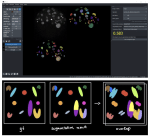
Quality assurance of segmentation results

Posted by , on 13 April 2023

This blog post revolves around determining and improving the quality of segmentation results. A common problem is that this step is often omitted and done rather by the appearance of the image segmentation than by actually quantifying it. This blogpost aims to show different ways to achieve this quantification as this leads to reproducibility. Therefore,

Annotating 3D images in napari

Posted by , on 30 March 2023

This blog post revolves around generating ground truth in 3D images for segmentation. Therefore, we will define what ground truth is and how we can generate it using napari in a time-efficient way. We will also learn about difficulties of annotating alone or in groups and address possible solutions for both. Challenges of image segmentation

TrackMate-Oneat: Auto Track correction using deep learning networks

Posted by , on 4 July 2022

During the tracking of motile cells, solving the problem of linking objects between two consecutive timepoints becomes even more complicated, if the cells divide or undergo cell death. In the terms of trajectories, this means the addition of trajectory branches and terminations. However, dividing and dying cells are characteristic in their shape, and leveraging this

Etch A Cell - segmenting electron microscopy data with the power of the crowd

Posted by , on 16 July 2020

Recent years have seen remarkable developments in imaging techniques and technologies, producing increasingly rich datasets that require huge amounts of costly technological infrastructure, computational power and researcher effort to process. Techniques such as light-sheet microscopy and volume electron microscopy routinely generate terabytes worth of data overnight. With a single data acquisition producing more images than