

Register for FocalPlane features… quantitative plant imaging across scales
Posted by FocalPlane, on 26 May 2026
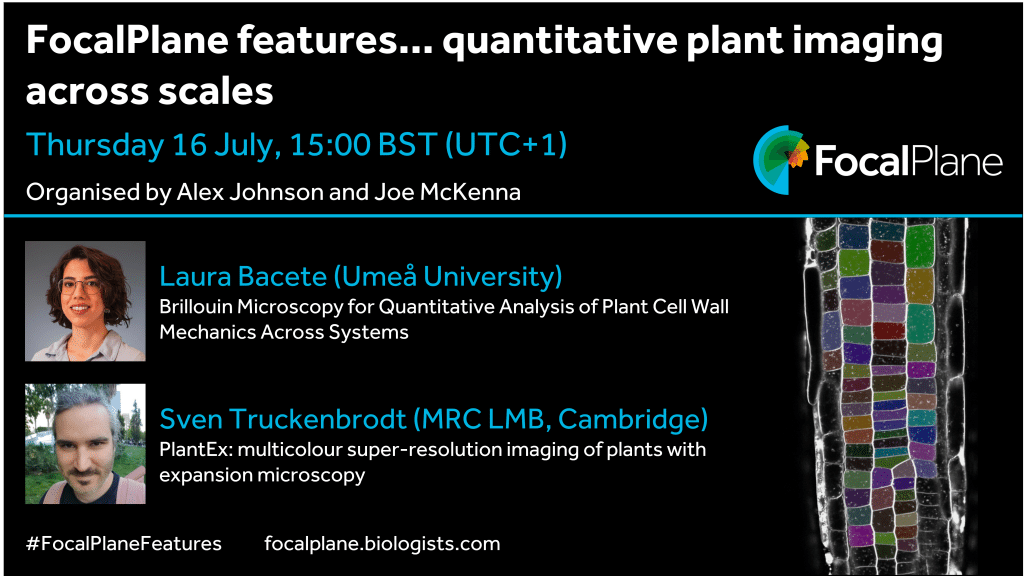
We are delighted to announce the speakers for the second webinar in our new series on quantitative plant imaging across scales, hosted by Alex Johnson (University of Exeter) and Joe McKenna (Warwick University). The second webinar will take place on Thursday 16 July at 15:00 BST, when we’ll hear talks from Laura Bacete (Umeå University) on ‘Brillouin Microscopy for Quantitative Analysis of Plant Cell Wall Mechanics Across Systems’ and Sven Truckenbrodt (MRC LMB, Cambridge) on ‘PlantEx: multicolour super-resolution imaging of plants with expansion microscopy’.
The goal of this new series is to bring together researchers working at different scales to begin understanding how we can integrate them to generate holistic understanding of plant biology from the single molecule to whole plants. We will also invite speakers from outside the plant fields to enable cross model knowledge and technical exchange. If you missed the first webinar you can catch up on the presentations from Thomas Ott (on behalf of Beatrice Lace) and Simon Gilroy on FocalPlane.
Our next webinar will be on 15 October and we’d love to hear from researchers that would like to share their research with the community.
Laura Bacete, Umeå University
Brillouin Microscopy for Quantitative Analysis of Plant Cell Wall Mechanics Across Systems
Umeå Plant Science Centre, Plant Physiology Department, Umeå (Sweden) / Department of Biology, NTNU, Trondheim (Norway)
Mechanical properties of plant cell walls regulate growth, morphogenesis, and stress responses, yet remain difficult to measure in living tissues. Brillouin microscopy is an optical technique based on light scattering by thermally driven acoustic waves, which provides access to local viscoelastic properties without physical contact or labels, and can be applied to intact, hydrated samples. I will present how my group uses Brillouin microscopy to study cell wall mechanics across diverse plant systems. Our work includes Arabidopsis roots, root hairs, and leaf pavement cells, as well as cotton fibres and aspen wood samples. We combine Brillouin imaging with genetic and chemical perturbations of wall composition, supported by correlative confocal microscopy and quantitative analysis pipelines adapted to heterogeneous wall regions. Together, these approaches enable cross-system comparisons that link wall composition, mechanical state, and function, and define practical strategies for quantitative plant cell wall mechanobiology
Sven Truckenbrodt, MRC LMB, Cambridge
PlantEx: multicolour super-resolution imaging of plants with expansion microscopy
Cellular structures supporting key cell biological processes — as diverse as cytoskeletal architecture, organelle trafficking and chromatin reorganisation — are built on the scale of tens of nanometres. The optical diffraction barrier — caused by the wave-like properties of light — prevents us from directly observing these events in conventional light microscopy. One powerful way around this limitation is expansion microscopy, a technology introduced 10 years ago in which biological samples are physically increased in volume by >1,000-fold to separate fluorophores until they can be resolved. I provide here an introduction to PlantEx, the first protocol for expansion microscopy of intact plant tissue. We applied PlantEx in the root tips of Arabidopsis thaliana to reveal cytoskeletal organisation, Golgi vesicle trafficking and microtubule rearrangement during mitosis at a resolution of 60 nm. By combining expansion microscopy and STED super-resolution imaging, we were able to further push the resolution to about 20 nm. I also show how PlantEx enables unlimited multi-colour super-resolution imaging on conventional confocal microscopes. Finally, we demonstrated how pan-protein labelling can be used to reveal the entire cellular organisation of plant cells — akin to electron microscopy — in an unbiased antibody-free manner. PlantEx thus provides a powerful toolkit for studying diverse questions in plant biology.