

Imaging spotlight: FidlTrack
Posted by FocalPlane, on 10 August 2026
In this Imaging spotlight, Pierre Parutto and Edward Avezov introduce single-particle tracking (SPT) and present FidlTrack, their new method for benchmarking and optimising SPT.
What is Single-Particle Tracking (SPT)?
Single-Particle Tracking (SPT) is a microscopy-based technique that enables the visualization and analysis of individual protein molecules in living cells. Monitoring the movement of single proteins over time provides information about their dynamics, interactions, and biological functions in their native cellular environment.
In practice, SPT experiments generate trajectories from single-molecule imaging data. These trajectories can be analysed to extract quantitative parameters such as diffusion coefficients, dwell times, and modes of motion. Relating these measurements to spatial information, cellular context, or experimental perturbations provide insights into protein function and regulation.
SPT has been widely used to study a variety of biological processes, including the behaviour of synaptic receptors in neurons and the motion of proteins within organelles.
What are the challenges of SPT data acquisition?
Trajectories sit at the interface between the experimental and computational components of an SPT workflow. Even the most sophisticated analysis methods will produce unreliable results if the underlying trajectories are inaccurate.
Generating high-quality trajectories from single-particle recordings is, however, far from trivial. Unlike tracking people in surveillance videos—where individuals can often be distinguished by characteristics such as appearance, size, or clothing—proteins observed in SPT experiments are visually indistinguishable. As a result, tracking becomes a balance between observing enough molecules to generate meaningful data while maintaining sufficient separation between them to allow unambiguous tracking over time.
Achieving this balance requires careful optimisation of a range of parameters, including:
- Experimental parameters: cell type, protein expression level, labelling strategy, and fluorophore choice.
- Microscopy parameters: laser power, frame rate, exposure time, and imaging modality.
- Computational parameters: tracking algorithms and settings.
The optimal combination depends heavily on the protein under investigation and the biological question being addressed, often requiring substantial expertise and trial-and-error experimentation.
Furthermore, although multiple software pipelines exist for generating trajectories, there is currently no widely adopted standard for evaluating their quality and reliability.
What does FidlTrack do?
FidlTrack addresses these challenges through a three-pronged approach designed to both improve and assess trajectory quality.
1. Predicting experimental complexity before acquisition
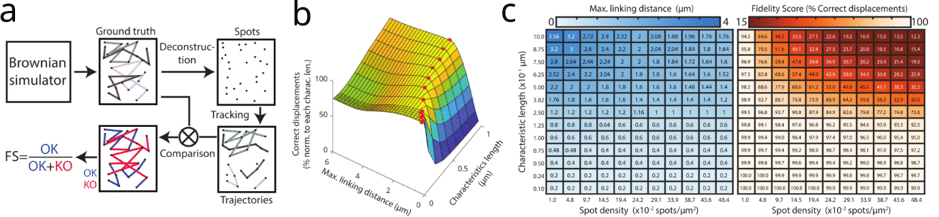
Before any experiment is performed, FidlTrack provides a simulation-based tool that estimates the difficulty of tracking a protein of interest and helps the design optimal experiments.
Using simulated ground-truth data covering a broad range of experimental conditions, the tool predicts tracking performance and assists in selecting appropriate tracking parameters (see Fig. 1).
2. Improving tracking through structure-aware distance measurements
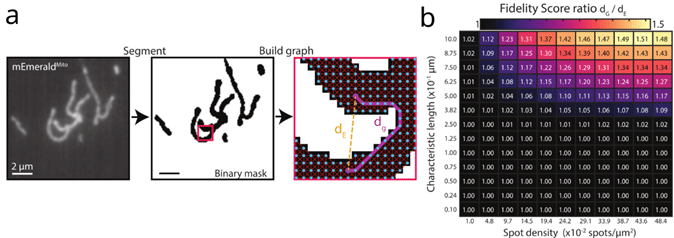
In many biological systems, proteins are confined to geometrically complex environments such as organelles, membranes, or neuronal projections. Because proteins cannot move freely through space, these structural constraints can be incorporated into the tracking process. FidlTrack leverages this information to improve trajectory reconstruction and reduce linking errors (see Fig. 2).
3. Quantifying trajectory quality after tracking
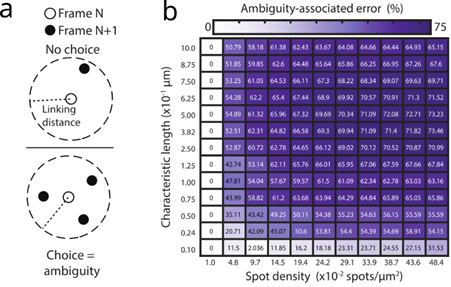
After trajectories have been generated, FidlTrack provides an ambiguity score that evaluates the quality of tracking results independently of the algorithm used.
The score estimates how often different particles come so close together that their identities cannot be followed unambiguously. This provides a quantitative measure of tracking reliability and highlights regions where errors are likely to occur (see Fig. 3).
Each of these components can be used independently or combined into a complete SPT workflow.
How do you use FidlTrack?
Experimental planning
When designing an SPT experiment, it is useful to evaluate its complexity with respect to trajectory generation. This can be done through the FidlTrack prediction notebook. The only required input is an estimate of the protein’s mobility, which may be obtained from previous experiments (e.g. FRAP), published measurements of similar proteins or preliminary SPT recordings.
The notebook predicts the optimal tracking parameters—such as the maximum linking distance—and estimates the expected tracking error. This provides an indication of the anticipated data quality and overall difficulty of the planned experiment.
Structure-aware tracking
To exploit structural information, the cellular structure containing the tracked proteins must first be imaged. This can be achieved in several ways:
- Acquiring a separate fluorescent image before or after SPT acquisition,
- Simultaneously imaging the structure and tracked particles in different channels,
- Using a high 405 nm illumination after SPT acquisition (for photoactivatable dyes) to reveal the bulk fluorescence of the structure.
Pre- or post-acquisition imaging is generally sufficient for relatively static structures such as neurites, whereas simultaneous imaging is preferable for highly dynamic structures such as mitochondria.
Once a structural image has been obtained, it is processed using a Python script that precomputes distances along the structure. Structure-aware tracking can then be performed in TrackMate using the dedicated FidlTrack plugin, together with the original recordings and the precomputed distance map.
Trajectory quality assessment
The ambiguity score is available as a Colab notebook requiring a trajectory dataset and the corresponding particle detections. From those, the notebook can either: compute a single score between 0 (best) and 100 (worst) reflecting overall trajectory quality or generate spatial maps showing where ambiguities occur.
FidlTrack is also provided a TrackMate plugin that identifies ambiguities directly during the tracking process.
Automated pipeline
For users seeking a fully automated workflow, FidlTrack also provides a complete SPT pipeline consisting of a collection of scripts that streamline and automate TrackMate-based analyses.
Where is FidlTrack useful?
The prediction module of FidlTrack is broadly applicable across virtually all SPT experiments. Because it relies on simulated ground-truth data covering a wide range of biologically relevant conditions—from slow membrane proteins to rapidly diffusing soluble proteins—it can be used to evaluate tracking performance before data collection.
Our analyses demonstrate that tracking parameters substantially influence trajectory quality. Parameters that are too restrictive prevent the formation of correct trajectories, while overly permissive settings increase particle confusion and tracking errors. For this reason, we also recommend the routine use of the ambiguity score as a quality-control metric.
The full FidlTrack workflow is particularly powerful for studying intracellular proteins. We have extensively applied it to proteins residing within the lumen and membranes of the endoplasmic reticulum (ER) and mitochondria. These organelles form extensive, highly structured networks whose geometry can be incorporated into structure-aware tracking. Moreover, luminal proteins often move rapidly while remaining confined within largely two-dimensional networks, making them ideal candidates for FidlTrack.
We have also successfully applied FidlTrack to the study of cytosolic proteins in thin neuronal projections. In this setting, proteins can travel long distances in a predominantly two-dimensional environment. The complex arrangement of intersecting neurites allows structural information to prevent erroneous linking between particles belonging to different cells.
More generally, FidlTrack is most beneficial when long, reliable trajectories are required, particularly in experiments involving fast-moving proteins, high particle densities and complex cellular geometries.
Using structural information significantly reduces tracking errors—as demonstrated through comparisons with simulated ground-truth datasets—and consistently lowers ambiguity scores.
Example applications
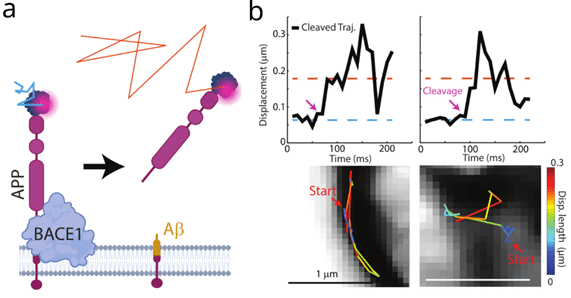
We are particularly interested in determining the status of proteins from their motion (e.g. binding or cleavage status). This requires long reliable trajectories that can be obtained in some organelles (e.g. ER) where the full extent of FidlTrack can be exploited.
Quantifying APP cleavage in the ER
FidlTrack was used to measure the cleavage rate of the Alzheimer’s disease-associated Amyloid Precursor Protein (APP) by β-secretase within the endoplasmic reticulum. Improved tracking quality enabled clearer discrimination between untreated cells and cells exposed to β-secretase inhibitors, reaching the resolution level necessary to see cleavage of individual APP in real time (see Fig. 4).
Detecting intrabody binding to target
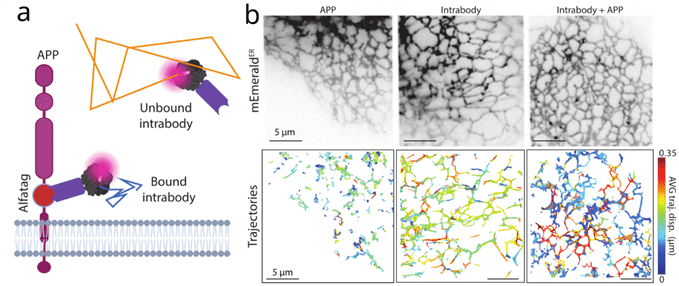
Changes in the motion of intrabodies can be used to estimate their binding status to their target proteins in situ. FidlTrack improves trajectory reliability sufficiently to quantify these subtle velocity changes and infer intrabody binding status in live cells (see Fig. 5).
Studying interactions with ER exit sites
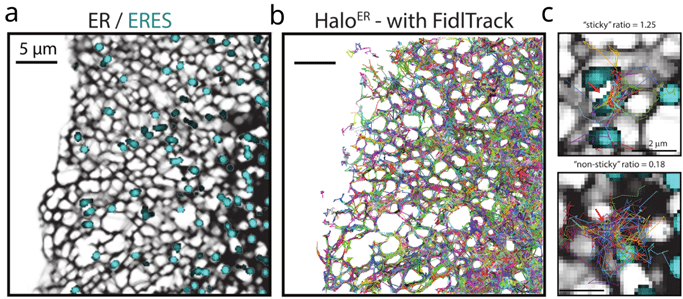
Interactions between ER-retained proteins and ER exit sites are relatively rare events, requiring high-density imaging to capture enough occurrences. High particle densities can introduce substantial linking errors, but FidlTrack reduces these artifacts, allowing the identification of distinct classes of ER exit sites. Some sites exhibit strong interactions with nearby proteins, whereas others show little or no trapping behaviour (see Fig. 6).
What are the prospects for FidlTrack?
The field of single-particle tracking is rapidly evolving. Advances in genome engineering technologies such as CRISPR knock-in strategies, together with improvements in microscopy hardware—including high-speed sCMOS cameras—are enabling the investigation of increasingly complex protein behaviours with higher precision.
These developments also increase experimental complexity, generate larger datasets, and require the detection of more subtle biological effects. We envision that FidlTrack will play an important role in meeting these challenges by producing higher-quality trajectories, improving confidence in downstream analyses, and increasing the level of automation throughout the SPT workflow.
Where can people find more information?
FidlTrack is fully open source and can be found in the following repositories:
- FidlTrack repository: https://github.com/Avezovlab/FidlTrack
- SPT Fidelity paper code and datasets: https://github.com/pparutto/SPT_fidelity
Both repositories include source code, documentation, and example datasets to help users get started.