




Advertisement

Displaying posts with the tag: is_archive

Scientific Data Analysis: User Documentation 101

Posted by , on 30 April 2023

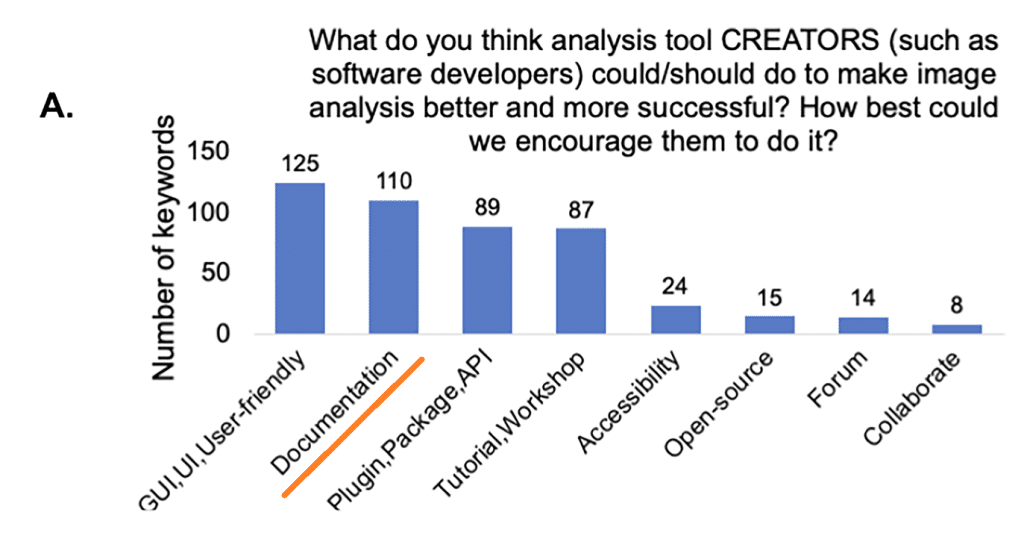
TL;DR: When publishing open-source tools for bio-image analysis special emphasis should be put on user-documentation. Users and developers have a different background and a language barrier limits knowledge exchange on how to use tools correctly. Writing a good user guide is a huge opportunity and worth the effort: Users get the most out of their

Quality assurance of segmentation results

Posted by , on 13 April 2023

This blog post revolves around determining and improving the quality of segmentation results. A common problem is that this step is often omitted and done rather by the appearance of the image segmentation than by actually quantifying it. This blogpost aims to show different ways to achieve this quantification as this leads to reproducibility. Therefore,

Fast4DReg - to the rescue of your drifty microscopy data

Posted by , on 10 March 2023

Fast4DReg to the rescue of your 4D microscopy data In life sciences, researchers use microscopes to study living organisms, such as cells or small animals. These live cell imaging experiments are usually performed over several hours, exposing the experiment to changes in the sample and in the microscope surroundings – causing the data to drift.

Rescaling images and pixel (an)isotropy

Posted by , on 2 March 2023

This blog post shows the importance of rescaling 3D image data and what anisotropy of pixels/voxels has to do with it. We will see which different options exist to rescale an image as well as their advantages and limitations. We will also apply a commonly used segmentation algorithm, Voronoi-Otsu-Labeling, on the original and the rescaled

Sharing research data with Zenodo

Posted by , on 15 February 2023

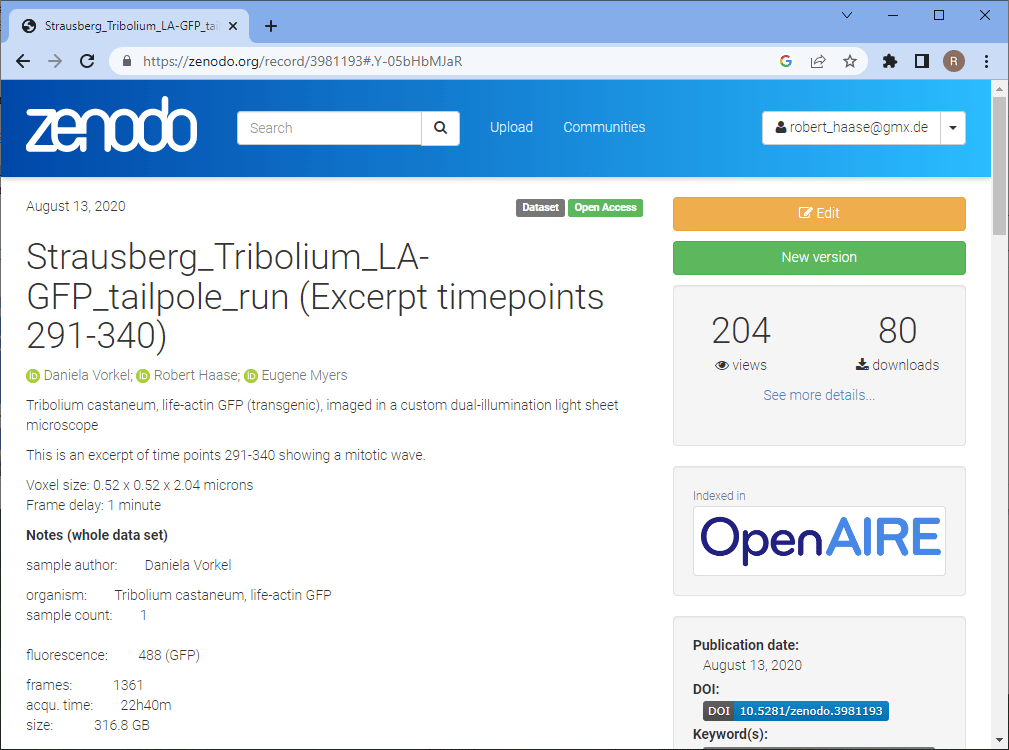
TL;DR: Sharing data open access is good scientific practice. If data is shared via online portals such as https://zenodo.org, we can implement best practices for sharing, licensing, reusing and citing research data. In this blog post I guide through the minimal procedures that are necessary to share a dataset publicly following the FAIR principles; to

Affimers – small probes for big imaging experiments

Posted by , on 9 August 2022

Antibodies have been used to label proteins of interest since the 1970s. However, their large size (around 15 nm long for IgG) makes the penetration of dense structures within the cell a challenge and places the fluorophore away from the target protein. This latter issue, known as a ‘linkage error’, particularly impacts accuracy and precision

Protein micropatterning: beauty standards in cell culture

Posted by , on 16 February 2022

When imaging cells grown on a flat substrate, such as a glass coverslip, we quickly admire the diversity of morphologies different cells can take on. Some cells, such as COS7, will take on a flat “pancake”-like shape, which makes it easy to image its organellar structure in a 2D plane. On the other hand, a

DeepImageJ: Deep learning in bioimage analysis for dummies

Posted by , on 2 December 2021

Written by Estibaliz Gómez-de-Mariscal, Cristina de-la-Torre-Gutiérrez, Arrate Muñoz-Barrutia, and Daniel Sage Do you invest significant time looking for tools to analyze your microscopy images? Probably you have already heard about the extraordinary capabilities of deep learning (DL) to reveal complex visual structures in images. If you are a biologist practicing daily ImageJ, you may look

Overview of Microscopy Techniques: Confocal, Widefield, Transmitted Light and Deconvolution

Sponsored by Andor, on 30 November 2021

Microscopes are an essential tool for modern life science applications. From medical diagnostics (for example, identifying the source of an infection, or the severity of a tumour) to food analysis.  With such demand it is not surprising that in the last decade, there has been a boom in microscopy technologies allowing researchers to see beyond

Primed conversion: the Basics

Posted by , on 15 November 2021

It has been a bit more than 6 years since the first “primed conversion” article1 was published in May 2015 and around 3 years since I first heard about this new photoconversion technique. I recall that it was almost 1 year after I got my MSc in Greece when I contacted Dr Periklis (Laki) Pantazis