



Advertisement

Displaying posts with the tag: is_archive

EMBL Imaging Centre: Enabling imaging across scales

Posted by , on 17 June 2022

With its first symposium, the EMBL Imaging Centre introduced its services, aims, and missions to the scientific community, celebrated advancements in imaging, and provided a sneak-peek into the cutting-edge technologies and advanced training it will make accessible to researchers all over the world.

FocalPlane features... Jennifer Lippincott-Schwartz

Posted by , on 1 June 2021

In case you missed our first ‘FocalPlane features…’ event, here is the recording of the webinar given by Jennifer Lippincott-Schwartz on Tuesday 4 May 2021. Powerful new ways to image the internal structures and complex dynamics of cells are revolutionizing cell biology and bio-medical research. In this talk, I will focus on how emerging fluorescent

SRRF-Stream+ Super-Resolution Microscopy Accessible to All

Sponsored by Andor, on 12 August 2020

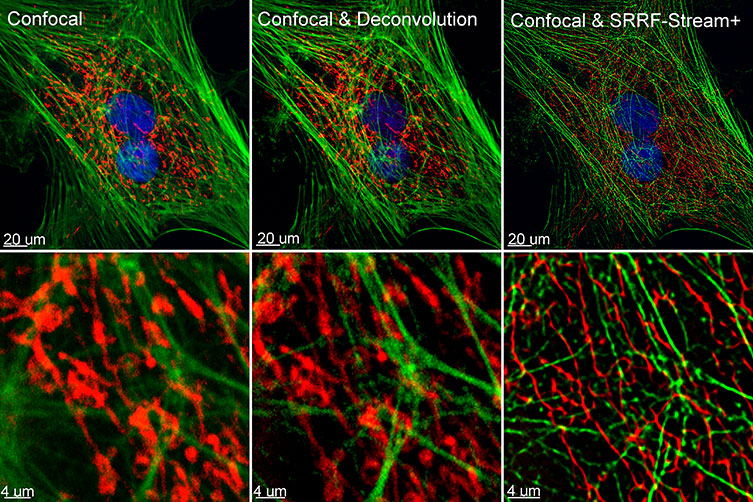
Fast, reliable & live-cell compatible Super-Resolution Science has limits imposed by the laws of physics that constrain discoveries and the advance of knowledge. In microscopy, up until the beginning of the XXI century, the diffraction limit of light was an unbreakable barrier. This law of physics imposes that two points could not be resolved (clearly

Expansion microscopy

Posted by , on 29 July 2020

Written by Shoh Asano and Ruixuan Gao Light microscopy and diffraction limit For centuries, light microscopy has played a central role in biological studies. The first implementations of a light microscope dates back to as early as the late 16th and early 17th century, when an array of polished lenses was used to magnify (biological)

The cell biologist's guide to super-resolution microscopy

Posted by , on 1 July 2020

Super-resolution microscopy has allowed to resolve cellular structures down to the nanoscale. While extremely beneficial for most cell biologists, the advent of this technology has made it somewhat difficult for cell biologists and microscopists alike to select the techniques best suited for their experiments. Guillaume Jacquemet, Alexandre Carisey, Hellyh Hamidi and two members of our