

Featured image with Nat Prunet
Posted by FocalPlane, on 27 March 2026
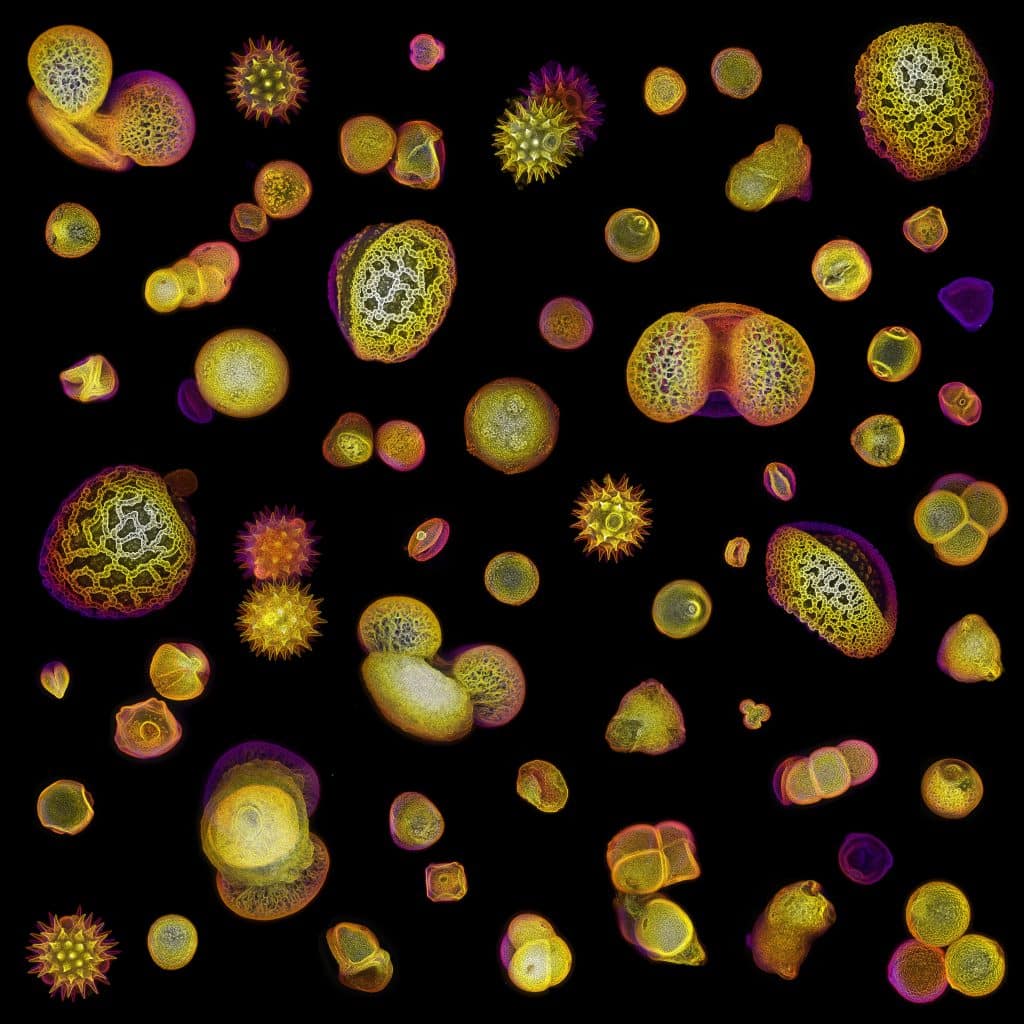
Our featured image from Nat Prunet is a composite image of pollen grains from various plant species. Each pollen grain was imaged separately for red autofluorescence with super-resolution Airyscan on a Zeiss LSM 980 microscope. 3D datasets were processed on Fiji with edge-finding and color-coding for depth.
Discover more about Nat’s research.
Research career so far: I’m a plant developmental biologist by training. My PhD and postdoc focused on flower development in Arabidopsis. I was drawn to developmental bio after an internship I spent imaging fertilization in Arabidopsis on a confocal microscope. I was fascinated by what confocal allows us to see, and by the beauty of the images it generates. After my postdoc, I decided I wanted to reorient my career towards microscopy. I took two advanced microscopy courses, and started shortly after as a the director of a microscopy core facility. As a microscopist, I have the opportunity to work at the intersection of science and art, and I love it. I also teach optical microscopy to upper division undergrads and grad students.
Current research: As a microscopy core director, I no longer lead my own research project, but I still do collaborative research on microscopy-heavy projects, both on plant developmental biology with labs in Europe that lack microscopy skills or equipment, and locally on a variety of topics with labs using my core.
Favourite imaging technique: My favorite imaging technique is confocal. It might be slow, but I love the crisp, high signal-to-noise ratio it generates, and the versatility of it.
What are you most excited about in microscopy? I’m really excited about the commercial implementation of light-sheet microscopy in more turnkey, user-friendly systems. The speed and gentleness of light sheet really allows us to image biological specimens on the long term and/or at high temporal resolution, which is critical to understand highly dynamic biological phenomena. However, homebuilt light-sheet microscopes require a lot of expertise and are easily misaligned. As a microscopy core director, I need systems that have less of a steep turning curve, and are more robust. I’m also really interested in recent development in super-resolution microscopy, like MINFLUX, which gives use access to sub-nanometer resolution.
 (No Ratings Yet)