



Advertisement

Displaying posts with the tag: is_archive

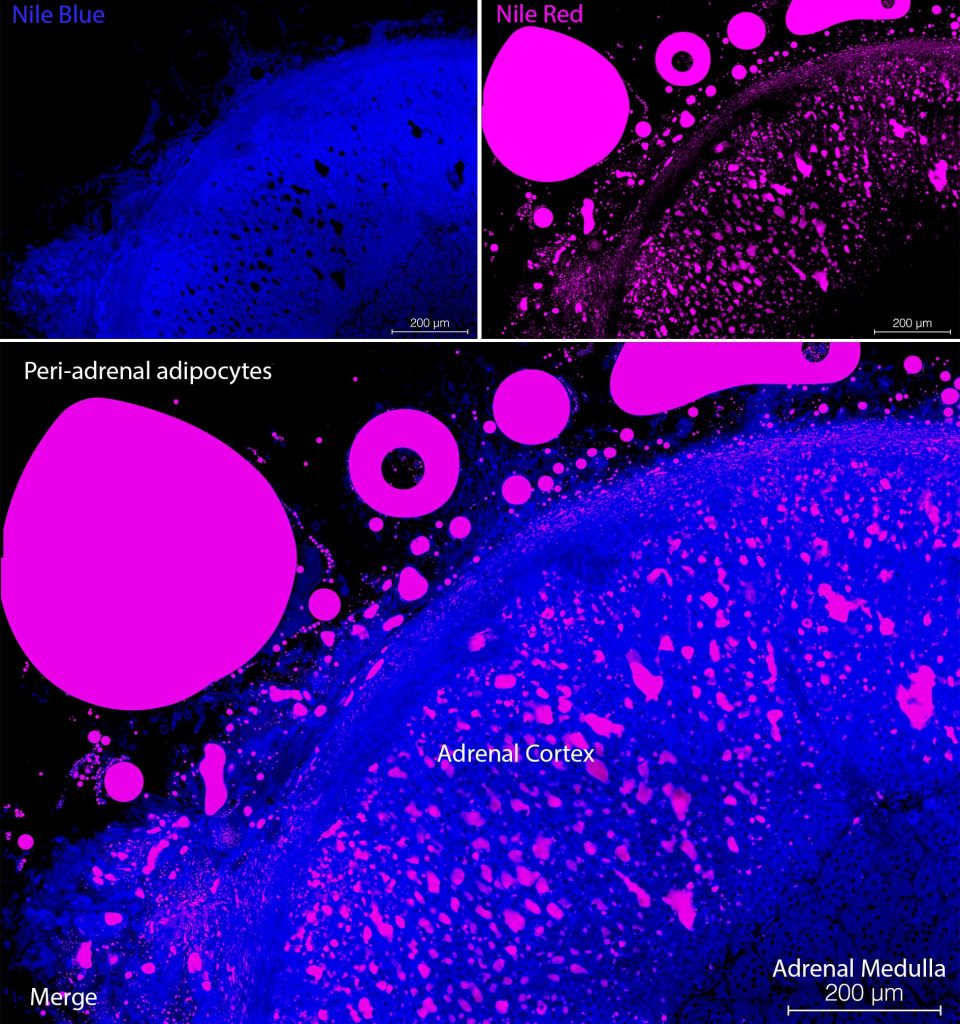
Using Nile Blue and Nile Red to visualise the presence of lipids in cryosectioned tissues

Posted by , on 14 September 2021

Lipids are crucial elements of mammalian (and non-mammalian) cell biology and yet lipids are challenging to visualise in situ. In comparison to proteins, which we can generate antibodies for, or carbohydrates, some of which we can detect using fluorescent lectins, there are relatively few lipid-specific fluorescent probes. Many lipids are highly conserved across species making

Tissue clearing: what invisible samples reveal about biology

Posted by , on 8 September 2021

Written by Jorge Almagro and Hendrik Messal The tissues that constitute organs exist in our body in 3D. However, for practical reasons, histological analysis has been traditionally performed in 2D, slicing a few micrometer-thick sections to analyse them under the microscope. While this has been critical to understand our anatomy for centuries, it constitutes a simplification of

Collaborative bio-image analysis script editing with git

Posted by , on 4 September 2021

TL;DR: I’m a computer scientist who often collaborates with biologists on bio-image analysis scripts. We are using more and more git, a version control program, for working on code collaboratively. When using git, we speak about repositories, commits and pushing to the origin. We also make forks, send pull-requests and merge code. This blog post

Considerations for expression of fluorescent proteins and imaging in mammalian cells

Posted by , on 7 July 2021

Introduction to fluorescent proteins  Fluorescent proteins have the property of absorbing light at one wavelength and emit light in a longer wavelength. These proteins were observed first in bioluminescent organisms known to humanity for centuries. We can find examples of light-emitting organisms in multiple taxa: from single cell organisms like bacteria, to vertebrates like fish.

A First Exposure to Super-Resolution Microscopy

Posted by , on 11 June 2021

Biomedical research encompasses several fields of expertise involving complex biological topics and technologies. Studying a given subject is a process that takes years, decades, and sometimes a lifetime to complete. Consequently, researchers tend to become highly familiar with a specific subset of scientific topics and experimental approaches. However, they are often confronted with the cumbersome

What is Expansion Microscopy?

Sponsored by Andor, on 27 May 2021

How can you get the most information from expanded samples? Traditional light microscopy is limited by the diffraction of light, consequently, features less than 200 nm apart cannot be resolved. For a significant time microscopy technique development was focused towards improving imaging techniques to allow for individual molecules to be resolved. Super-resolution microscopy was developed

Preparing your manuscript: guidelines for writing microscopy methods and figures

Posted by , on 25 May 2021

A new paper has caught your eye on Twitter or Pubmed based on the title. Next step? A quick look at the abstract. Still interesting? Let’s have a look at the figures. This is probably the most important element of the paper to attract the interest of the reader. If figures are easy to interpret

Phototoxicity - the good, the bad and the quantified.

Posted by , on 14 May 2021

Our virtual meeting on phototoxicity was held in late January 2021, generously sponsored by the European Microscopy Society and enabled by the Royal Microscopical Society. In four hours, spread over two days, the five organisers and twenty invited participants discussed the problem of phototoxicity in live imaging, and how we can start to tackle this

A biologist’s checklist for calcium imaging and optogenetic analysis

Posted by , on 12 April 2021

Technological advancement constantly makes these methods more accessible, however, there are a number of understated complexities involved with these types of imaging-based experiments

Bioimage Analysis in FIJI - Resource List

Posted by , on 14 September 2020

If you are on this site, you might be aware of some of the open source image processing and analysis tools are available to you. The toolbox in this space is rapidly expanding. But that doesn’t always mean it’s easy to navigate – it can actually be quite daunting. Luckily the bio-imaging community is friendly