




Advertisement

Displaying posts with the tag: is_archive

Turn Your Inverted Microscope into a Multimodal Nanoscope

Sponsored by Olympus, on 14 June 2021

Among recent nanoscopy techniques that break the diffraction limit, single-molecule localization microscopy (SMLM) contributes to major discoveries in medicine and biology. It is now possible to see how subcellular molecular machineries form and behave inside single cells and to quantify single biological molecules such as proteins, nucleic acids, and lipids, at ultralow concentrations inside the

A First Exposure to Super-Resolution Microscopy

Posted by , on 11 June 2021

Biomedical research encompasses several fields of expertise involving complex biological topics and technologies. Studying a given subject is a process that takes years, decades, and sometimes a lifetime to complete. Consequently, researchers tend to become highly familiar with a specific subset of scientific topics and experimental approaches. However, they are often confronted with the cumbersome

Technology highlights - Traction Force Microscopy (TFM)

Posted by , on 9 December 2020

Interview with Aki Stubb, Ph.D. Please tell us a bit about yourself and the facility where you work. My name is Aki Stubb and I am a post-doctoral fellow at the University of Cambridge, UK. I did my PhD in the group of Johanna Ivaska at the Turku Bioscience Centre, University of Turku and Åbo

Technology highlights – Structured Illumination Microscopy (SIM)

Posted by , on 30 September 2020

Interview with Ivan Novotný, Ph.D., from the Light Microscopy Core facility at the Institute of Molecular Genetics, in Prague, Czech Republic. Please tell us a bit about yourself and the facility where you work. I am employed as an imaging specialist at the Light Microscopy Core facility at the Institute of Molecular Genetics of the

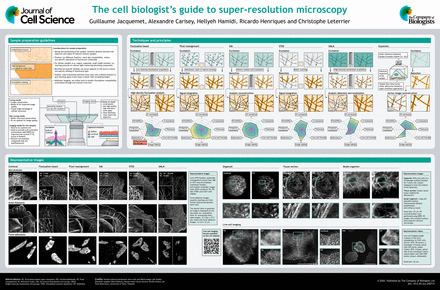
The cell biologist's guide to super-resolution microscopy

Posted by , on 1 July 2020

Super-resolution microscopy has allowed to resolve cellular structures down to the nanoscale. While extremely beneficial for most cell biologists, the advent of this technology has made it somewhat difficult for cell biologists and microscopists alike to select the techniques best suited for their experiments. Guillaume Jacquemet, Alexandre Carisey, Hellyh Hamidi and two members of our